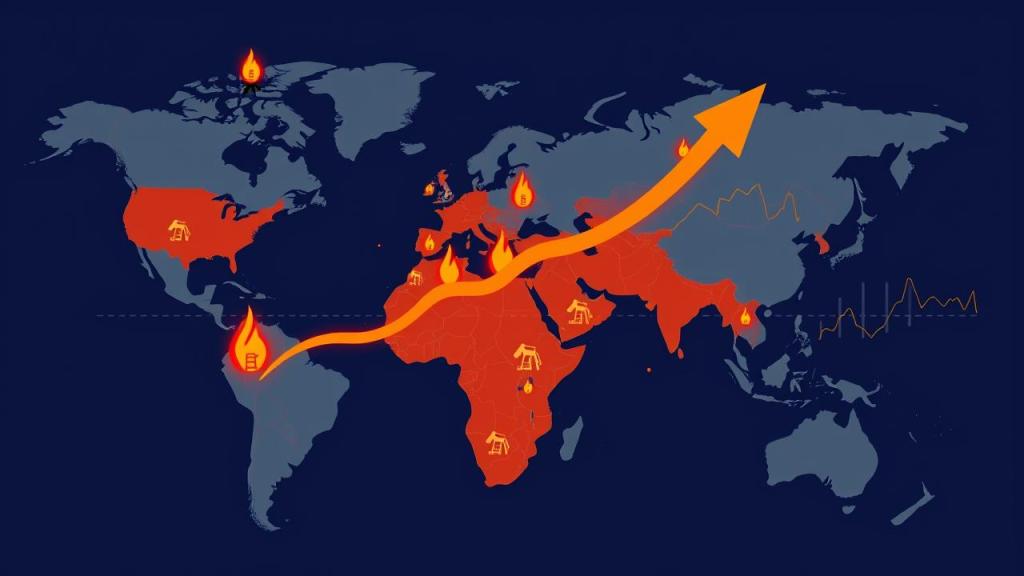
🌐 Global Economy Briefing — April 21, 2026
The global economy is navigating its most treacherous terrain since the pandemic, as an escalating Middle East conflict has unleashed an energy supply shock that is simultaneously driving oil prices toward multi-year highs, stoking inflation, and forcing the IMF to cut its 2026 growth forecast. From Wall Street’s tech-led stumble to Asia’s widening current-account gaps, the war’s economic aftershocks are now impossible to ignore.
🌍 IMF Slashes Growth Outlook as Middle East War Reshapes Global Economics
🔥 Worst Growth Outlook in a Generation
The IMF’s April 2026 World Economic Outlook cut global growth projections to just 3.1% for 2026 — well below pre-pandemic averages — as the Middle East war drives commodity prices higher, tightens financial conditions, and darkens the policy landscape for governments worldwide.
📰 From Resilience to Rupture: How War Broke the Recovery Narrative
After surviving successive crises — COVID, the 2022 energy shock, and aggressive rate hikes — the global economy had seemed to be finding its footing. Then the Middle East conflict erupted, instantly repricing risk assets, rerouting shipping through costlier lanes, and forcing central banks to reconsider rate-cut timelines. Defense spending surges now threaten to crowd out social investment in advanced economies.
📊 KEY DATA
▸ 2026 global growth forecast: 3.1% (down from prior 3.3%) ▸ 2026 global headline inflation: 4.4% ▸ Adverse scenario growth: 2.5% ▸ Severe scenario growth: 2.0% ▸ Severe scenario inflation: 6.0%
🌍 Fiscal Buffers Eroding Just When Governments Need Them Most
Advanced economies ramping up defense budgets face a painful trade-off: short-term GDP boosts come at the cost of larger deficits, higher debt servicing costs, and reduced capacity to fund healthcare and social safety nets. Emerging markets dependent on external financing face additional pressure from tighter global liquidity and a stronger U.S. dollar.
👁 WHAT TO WATCH
IMF Spring Meetings conclusions are due this week. Watch for G20 communiqué language on coordinated energy policy and whether the IMF activates emergency financing facilities for heavily affected low-income nations. Next global growth update expected July 2026.
🎙 EXPERT TAKE
“The conflict is testing the resilience that the global economy has shown in recent years. Policy space is narrower now, and a miscalculation could tip vulnerable economies into a downward spiral.” — IMF Chief Economist, April 14, 2026 WEO Press Briefing
💡 War Has Replaced Inflation as the World Economy’s Defining Threat
The era of pandemic recovery is over — geopolitical conflict is now the primary variable determining whether 2026 ends in a soft landing or a synchronized global slowdown.
🛢️ Oil Surges as Strait of Hormuz Fears Grip Energy Markets
🔥 Brent at $96 and Climbing — $115 in Sight
Brent crude rose to $96.26/barrel on April 20, up over 5% in a single day, as markets priced in escalating risk of disruption to oil flows through the Strait of Hormuz — the critical chokepoint through which roughly 20% of global oil supply passes each day.
📰 A Chokepoint Under Threat: Why the Hormuz Premium Is Back
Production shut-ins linked to the conflict averaged 7.5 million barrels per day in March 2026, with the EIA projecting that figure could peak at 9.1 million b/d in April. That scale of disruption rivals the 1973 Arab oil embargo in its potential inflationary impact, forcing energy traders to price in a prolonged “Hormuz risk premium.”
📊 KEY DATA
▸ Brent crude (Apr 20): $96.26/barrel ▸ EIA Q2 2026 peak forecast: $115/barrel ▸ Projected production shut-ins: 9.1M b/d (April peak) ▸ Hormuz closure impact on U.S. PCE inflation: +0.35 to +1.47 pp ▸ IEA 4Q26 average forecast: $88/barrel
🌍 Import-Dependent Economies Bear the Sharpest Pain
For energy-importing nations in South and Southeast Asia — India, Pakistan, the Philippines, Vietnam — surging oil prices directly translate into wider current account deficits, weaker currencies, and renewed inflationary pressure. European consumers, already strained by two years of elevated energy bills, face another cost-of-living squeeze, while fuel subsidies in low-income nations are straining already fragile public finances.
👁 WHAT TO WATCH
Monitor OPEC+ emergency meeting signals over the coming weeks; any decision to boost output could cap the price rally. Also watch U.S. Strategic Petroleum Reserve (SPR) release announcements and Iran nuclear diplomacy developments, which remain the primary swing factor for Hormuz risk pricing.
🎙 EXPERT TAKE
“If Hormuz is closed for even two weeks, we’re looking at an inflation shock that would make 2022 look manageable by comparison. Central banks would face an impossible choice between fighting inflation and supporting growth.” — J.P. Morgan Global Research, Oil Price Forecast, April 2026
💡 The World Runs on a Chokepoint — and That Chokepoint Is Now a Battleground
Until the Strait of Hormuz risk premium is resolved, every other economic variable — inflation, growth, interest rates — remains hostage to a single narrow waterway.
🇺🇸 U.S. Markets: Jobs Hold Firm, But Tech Titans Stumble
🔥 Magnificent Seven Fall From Grace — Down 12% Year to Date
The “Magnificent Seven” mega-cap tech stocks — which once seemed invincible — have collectively declined roughly 12% year to date in 2026, with four members (Microsoft, Tesla, Apple, and Alphabet) suffering double-digit losses. Their underperformance is dragging significantly on the S&P 500, given they represent approximately one-third of the index by market cap.
📰 Geopolitics and Guidance Gaps Dethrone the AI Trade
The combination of geopolitical uncertainty, rising energy costs (which hit data center operators hard), and weaker-than-expected earnings guidance has eroded investor confidence in the AI-driven growth narrative that powered 2024–2025 market gains. Netflix’s 10% single-day drop on weak subscriber guidance further rattled sentiment on April 21, though broader indexes remained on track for a third consecutive weekly gain.
📊 KEY DATA
▸ Magnificent Seven YTD decline: ~12% ▸ S&P 500 projected 2026 EPS growth: +16% ▸ March payroll additions: 178,000 (above consensus) ▸ Three-month moving average payroll: 68,000 ▸ Netflix share drop (Apr 21): -10% on weak guidance
🌍 Dollar Strength Exports Pressure to Emerging Markets
Risk-off sentiment driven by geopolitical tension has firmed the U.S. dollar, amplifying financial stress in emerging economies that borrowed heavily in dollar-denominated debt. Countries across Latin America and Sub-Saharan Africa face higher import bills and tighter refinancing conditions as a result of the dollar’s relative strength in 2026.
👁 WHAT TO WATCH
Key Q1 2026 earnings this week from GE Aerospace, UnitedHealth, 3M, and United Airlines will offer insight into how industrial America is weathering the energy shock. The next Fed meeting and updated dot-plot will clarify whether rate cuts remain on the table for mid-2026.
🎙 EXPERT TAKE
“The labor market is proving stickier than the bears expected — 178k jobs in March is genuinely solid. But with energy prices rising and tech multiples deflating, the consumer’s resilience will be tested heading into summer.” — Mutual of America, Economic & Market Perspective, April 2026
💡 America’s Economy Is Still Growing — Just Not Where the Headlines Said It Would
The U.S. expansion is alive, but the AI-fueled tech rally that defined recent years is losing steam, and energy-cost headwinds are about to test whether the real economy can carry the baton.
🌏 Asia-Pacific: Energy Shock Puts Regional Growth on the Line
🔥 Inflation Doubles in Emerging Asia as Oil Reprices Everything
The IMF’s Regional Economic Outlook for Asia-Pacific warns that inflation in emerging Asia is set to more than double — from 1.1% in 2025 to 2.6% in 2026 — driven by the energy price shock emanating from the Middle East conflict, with South Asia facing the steepest growth slowdown in the region.
📰 A Region That Runs on Imported Energy Hits a Wall
Asia-Pacific’s rapid post-pandemic growth was built on cheap energy imports, robust semiconductor exports, and strong consumer spending. Now all three pillars are wobbling simultaneously: energy costs are surging, export demand is softening as global growth slows, and household budgets are being squeezed. South Asia’s growth is expected to decelerate from 7% in 2025 to 6.3% in 2026, while broader Asia moderates from 5% to 4.4%.
📊 KEY DATA
▸ Asia-Pacific 2026 growth forecast: 4.4% (down from 5.0% in 2025) ▸ Developing Asia growth: 5.1% in 2026 ▸ South Asia 2026 growth: 6.3% (vs. 7.0% in 2025) ▸ Emerging Asia inflation 2026: 2.6% (up from 1.1% in 2025) ▸ China 2026 IMF forecast: 4.4% (revised up 0.2pp)
🌍 China’s Relative Stability Becomes the Region’s Anchor
As neighbors grapple with energy-driven inflation and weakening currencies, China’s relatively insulated position — with its state-directed energy strategy and domestic demand pivot — makes it a comparative anchor of regional stability. Chinese exporters are also successfully redirecting shipments to European markets, partially offsetting weaker U.S. demand. Still, China’s own 4.4% growth target is under pressure from persistent domestic demand weakness and geopolitical headwinds.
👁 WHAT TO WATCH
Asian Development Bank’s April 2026 outlook updates are due this week. Watch for central bank responses in India and Indonesia — both face a dilemma between defending currencies and supporting growth. China’s April PMI data, due late April, will be critical for gauging whether manufacturing momentum can be sustained.
🎙 EXPERT TAKE
“Asia’s resilience is real, but it is being severely tested. The region entered this crisis with less fiscal space than in 2020, and the energy shock is arriving just as export momentum from semiconductor demand begins to fade.” — IMF Asia-Pacific Regional Economic Outlook, April 16, 2026
💡 Asia’s Growth Miracle Needs Cheap Energy — and Cheap Energy Is No Longer Guaranteed
The Middle East conflict has exposed a fundamental vulnerability at the heart of Asia’s development model: the region’s dynamism depends on energy it doesn’t produce, flowing through routes it doesn’t control.
※ This content is automatically generated from public news sources. For reference only — not investment advice.

