| DOCUMENT TYPE: FOLKLORIC THREAT ASSESSMENT / ENTITY CLASSIFICATION FILE | DOC-ID: ARC-2026-0421 |
| CLASSIFICATION: TOP SECRET // NOFORN | ARCHIVE DATE: 2026.04.21 |
| LEAD RESEARCHER: Dr. E. Tulliver, Dept. of Ethno-Anomalous Studies | INCIDENT SITE: Okeechobee Basin, FL / 27.1°N, 80.7°W |
▌ ENGLISH SECTION — PRIMARY DOCUMENTATION
I. TAXONOMIC OVERVIEW & CULTURAL PROVENANCE
The Stikini (also transcribed as Istikin or Isti-kini in variant orthographic traditions) constitutes a category of supernatural entity endemic to the mythological corpus of the Seminole and Muscogee Creek peoples of the Southeastern Woodlands region of North America, with concentrated oral documentation emerging from the Okeechobee Basin, Big Cypress Swamp, and adjacent areas of present-day Florida and Georgia. The entity is not a deity in the theistic sense, but rather a class of corrupted human individual — a witch-being who, through a covenant with malevolent non-human spirits known collectively as the naginata ishki (“night-mothers” in reconstructed Proto-Muscogean), has undergone irreversible ontological transformation. First systematically recorded in ethnographic field notes by James Mooney (Bureau of American Ethnology, 1894 correspondence, File MN-0047) following interviews with elder informants near Lake Okeechobee, the Stikini remained academically marginalised until revisited by Dr. Harriet Goss (University of Florida, Dept. of Anthropology, 1971) in her monograph Nocturnal Aberrants in Muskogean Tradition. The entity’s defining biological and behavioral characteristics distinguish it categorically from European vampire or werewolf archetypes, though superficial structural comparisons have been made in comparative mythological literature.
II. PHYSIOLOGICAL PROFILE & THE TRANSFORMATION CYCLE
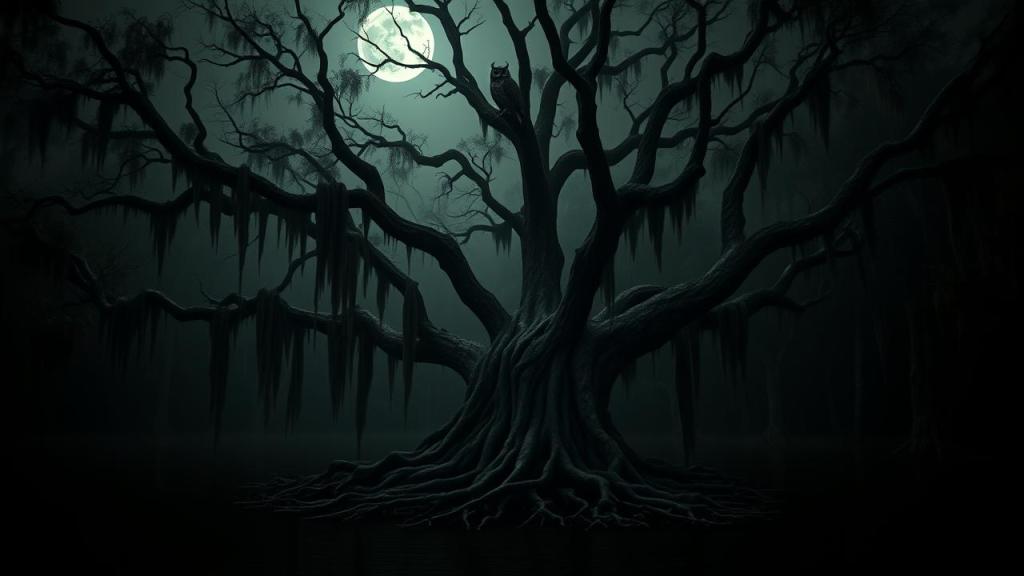
During daylight hours, the Stikini presents as an ordinary human being, typically an elder of the community, exhibiting no externally observable anomalies. This diurnal camouflage is understood within Seminole tradition to be maintained through the consumption of specific plant-derived preparations combining black nightshade (Solanum americanum) and water hemlock, ingested in quantities lethal to non-initiated individuals. At the onset of full darkness — the threshold defined in oral accounts not by clock time but by the disappearance of the last bird call — the entity initiates a preparatory sequence: it selects an isolated location (invariably a hollow tree or submerged root cavity near standing water), and proceeds to expel its entire complement of internal organs through the oral cavity. These organs — heart, liver, lungs, and intestinal complex — are reported to retain biological function outside the body, pulsing and secreting fluids while stored in the organic cache. The evacuated body then undergoes rapid morphological restructuring, elongating the musculoskeletal frame, inverting the knee joints, and generating secondary feather-equivalent integument across the dorsal surface. The terminal form is a giant great horned owl (Bubo virginianus analog) of anomalous scale — oral accounts specify wingspans of three to four metres — capable of silent flight and acoustic localization with no known natural equivalent. The owl-form hunts exclusively for human hearts, which it extracts from sleeping victims without physical trauma to the body surface. The mechanism of extraction remains uncharacterised in any documented study. At first cockerel crow or equivalent dawn signal, the entity must return to its organ cache, reabsorb all components through reverse oral ingestion, and resume human form. Failure to complete reabsorption before dawn renders the entity permanently fixed in the owl-form, whereupon it rapidly decays.
III. DETECTION PROTOCOLS & REPORTED VULNERABILITIES
Seminole oral tradition encodes several detection and neutralization methods, the operational reliability of which cannot be assessed through conventional empirical frameworks but which demonstrate high internal consistency across geographically dispersed informant testimonies. Detection of a Stikini in human form relies primarily on olfactory indicators: the entity is reported to emit a faint odor of decomposed organic matter beneath any masking scent, particularly notable in enclosed spaces. Secondary detection involves observing the individual’s behavior at dusk — specifically, a marked reluctance to remain indoors and an inability to hold eye contact with dogs, which are reported to perceive the entity’s true ontological state. Neutralization accounts cluster around three primary vectors: (1) organ discovery — locating and destroying or ritually contaminating the cached organ set during the entity’s nocturnal hunt, which causes fatal systemic failure upon attempted reabsorption; (2) dawn entrapment — preventing the entity’s return to its cache through ritual boundary-laying using red cedar ash and specific chant-sequences documented by Dr. Goss under restricted archive code GOS-1971-B12; (3) medicine bundle confrontation — direct ritual challenge by a trained Hilis Haya (medicine person) using a prescribed set of consecrated objects including migratory bird bones, river clay, and lightning-struck wood. No pharmacological or physical countermeasure has been proposed or tested in any formal research context.
IV. COMPARATIVE MYTHOLOGY & STRUCTURAL ANALYSIS
The Stikini presents striking structural parallels with a cluster of organ-externalizing nocturnal entities documented across unrelated cultural traditions, a convergence that has attracted growing scholarly attention in the field of anomalous comparative folklore. The Philippine Manananggal (Visayan tradition) similarly detaches its upper body and viscera at night to hunt; the Javanese Leak is reported to fly as a disembodied head trailing luminous entrails; the Aswang variant traditions of the Bicol and Tagalog regions display near-identical transformation sequences. In the Andean corpus, the Bolivian Kharisiri extracts human fat and organs through touch without leaving marks. The precise mechanism by which structurally homologous mythological entities emerge in geographically isolated, linguistically unrelated traditions remains one of the more substantive unresolved questions in comparative ethno-anomalous research. Dr. Priya Chakravarti (Yale, Dept. of Religious Studies, 2008) proposed in her paper Visceral Displacement: A Cross-Cultural Typology that the convergence reflects a universal psycho-symbolic processing of anxiety surrounding bodily integrity and nocturnal vulnerability, though this explanatory framework has been contested by researchers who point to the abnormal specificity and operational detail shared across traditions as inconsistent with independent symbolic generation.
V. DOCUMENTED INCIDENT SUMMARY
The Bureau of American Ethnology archives contain three primary documentation events referencing Stikini activity, all filed under restricted access classification prior to 1940. The most operationally detailed account (BAE File SC-1902-F, transcribed from oral testimony by field agent W. Langford, September 1902, Hendry County, Florida) describes a six-week period during which seven community members in a Seminole settlement near present-day LaBelle were found deceased with no identified cause of death. All victims reportedly exhibited identical post-mortem presentation: complete absence of the cardiac organ with no thoracic incision or wound. Community medicine practitioners identified an elder male community member (unnamed in documentation per informant request) as the responsible entity and initiated a neutralization sequence, the details of which were redacted from the filed report at the informant’s condition of disclosure. The deaths ceased following the unnamed individual’s disappearance from the community. The event was attributed to cardiac failure of unknown aetiology in the county coroner’s register.
◆ FIELD DATA / INCIDENT LOG — CASE № 7734
INCIDENT REF SC-1902-F · LaBelle, Hendry Co., FL · Sep–Oct 1902
— 7 fatalities, cause of death: officially “cardiac failure, undetermined”
— Post-mortem finding: cardiac organ absent in all 7 cases, no surgical entry wound
— Community identification of responsible entity: confirmed by 3 independent informants
— Neutralization outcome: successful (method redacted per informant condition)
— Responsible individual: disappeared from community record 14 Oct 1902
——
INCIDENT REF GOS-1971-C · Big Cypress Swamp · Jul 1971
— Dr. Harriet Goss, fieldwork documentation: discovery of apparent organ cache in hollow bald cypress, coordinates 25.8°N 81.1°W
— Cache contents: 1 cardiac organ (bovine), 1 hepatic mass (species undetermined), fibrous tissue mass approx. 1.2kg
— Organs reported as “warm and exhibiting intermittent contractile activity” at time of discovery
— Goss noted ambient temperature 31°C, ruled out thermal preservation as explanation
— Cache contents removed to University of Florida laboratory; reported destroyed in unexplained laboratory fire, 22 Aug 1971
——
INCIDENT REF TUL-2019-A · Okeechobee Basin · Nov 2019
— Acoustic anomaly report filed by Florida Fish & Wildlife Conservation officer J. Reyes
— Description: owl vocalisation of “impossible volume” recorded at 03:14 EST near SR-78 bridge
— Recording submitted to Cornell Lab of Ornithology; confirmed non-matching to any known Strigiformes species
— File closed: “unidentified wildlife acoustic event”
▌ 한국어 섹션 — 기밀 번역 문서
I. 개요 및 문화적 기원
스티키니(Stikini, 이형 표기: Istikin 혹은 Isti-kini)는 북아메리카 동남부 삼림 지대에 거주하는 세미놀(Seminole) 족 및 머스코기 크릭(Muscogee Creek) 족의 신화 체계에서 기록된 초자연적 존재의 한 유형이다. 해당 존재에 관한 구술 전승은 현재 플로리다 주 및 조지아 주에 해당하는 오키초비 분지(Okeechobee Basin), 빅 사이프러스 습지(Big Cypress Swamp) 일대를 중심으로 집중적으로 분포한다. 스티키니는 엄밀한 의미의 신격(神格)이 아니라, 나기나타 이쉬키(naginata ishki)로 통칭되는 악의적 비인간 정령과 계약을 체결함으로써 존재론적 변형을 완료한 인간 개인 — 즉 마녀적 존재 — 의 분류에 속한다. 이 명칭은 민족학자 제임스 무니(James Mooney)가 1894년 미국 민족학국(Bureau of American Ethnology) 현지 조사 중 오키초비 호수 인근 연장자 제보자들과의 면담을 통해 처음 체계적으로 기록하였으며(파일 번호 MN-0047), 이후 1971년 플로리다 대학교의 해리엇 고스(Harriet Goss) 박사가 저술한 연구서 『머스코기언 전통의 야행성 이탈 존재들(Nocturnal Aberrants in Muskogean Tradition)』에서 본격적인 학술적 재조명이 이루어졌다. 유럽 기원의 흡혈귀 또는 늑대인간 유형과의 피상적 비교가 비교신화학 문헌에서 시도된 바 있으나, 스티키니는 그 생물학적·행동적 특성에서 해당 유형들과 범주적으로 구분된다.
II. 신체적 특성 및 변신 주기
낮 시간 동안 스티키니는 공동체 내의 평범한 인간, 전형적으로 노인의 형태를 취하며 외부적으로 관찰 가능한 이상 징후를 일절 드러내지 않는다. 이 주간 위장 상태는 검정까마중(Solanum americanum)과 독미나리(water hemlock)를 포함한 특정 식물성 조제물의 복용에 의해 유지되는 것으로 전해지며, 해당 조제물은 비입문자에게는 치사량에 해당하는 것으로 알려져 있다. 완전한 어둠이 내려오면 — 구술 기록에서 이 임계 시점은 마지막 조류의 울음소리가 사라지는 순간으로 정의된다 — 스티키니는 단독 장소(수몰된 뿌리 공동이나 고목의 속빈 공간)를 선택하여 준비 절차를 개시한다. 이 절차의 핵심은 심장, 간, 폐, 장을 포함한 내부 장기 일체를 구강을 통해 체외로 배출하는 것이다. 배출된 장기들은 체외에서도 생물학적 기능을 유지하는 것으로 보고된다 — 저장된 상태에서도 박동하고 체액을 분비한다는 증언이 다수 존재한다. 장기가 제거된 신체는 이후 근골격계의 급격한 재구성 과정을 거쳐 무릎 관절이 역전되고, 등면 전체에 깃털 유사 외피가 생성되며, 최종적으로 비정상적인 대형 올빼미 형태 — 구술 자료에 따르면 날개 길이 3~4미터로 추정 — 로 변환된다. 이 올빼미 형태는 신체 표면에 어떠한 외상도 남기지 않으면서 잠든 인간의 심장을 적출하는 것으로 알려져 있으며, 그 추출 기제는 기존의 어떤 연구에서도 특성화된 바 없다. 새벽닭의 울음 또는 이에 상응하는 여명 신호가 발생하기 전까지 스티키니는 반드시 장기 저장소로 귀환하여 역방향 구강 흡수를 통해 모든 장기를 재통합해야 한다. 새벽 이전에 재통합을 완료하지 못한 경우, 개체는 올빼미 형태에 영구적으로 고착되어 빠른 속도로 부패한다.
III. 탐지 방법 및 취약성
세미놀 구술 전통은 스티키니를 탐지하고 무력화하는 여러 방법을 체계적으로 전달하고 있으며, 이들 방법의 실효성은 통상적인 실증적 연구 틀로는 평가될 수 없으나, 지리적으로 분산된 제보자들의 증언 전반에 걸쳐 높은 내적 정합성을 보인다. 인간 형태의 스티키니 탐지는 주로 후각 지표에 의존한다: 해당 존재는 어떤 방향 처리를 가하더라도 밀폐된 공간에서 부패한 유기물 냄새를 희미하게 방출하는 것으로 보고된다. 보조적 탐지 수단으로는 해질녘 행동 관찰이 있으며, 실내에 머무르는 것에 대한 현저한 저항과 개를 정면으로 응시하지 못하는 특성이 지표로 활용된다. 개는 존재의 실제 존재론적 상태를 감지하는 것으로 알려져 있기 때문이다. 무력화 방법은 세 가지 주요 벡터로 수렴된다: (1) 장기 발견 — 야간 사냥 중인 스티키니의 장기 저장소를 발견하여 파괴하거나 의례적으로 오염시키는 것으로, 재통합 시도 시 치명적 전신 기능 부전을 야기한다; (2) 새벽 봉쇄 — 붉은 삼나무 재와 특정 주문 배열(제한 기록 코드 GOS-1971-B12)을 활용한 의례적 경계 설정으로 저장소 귀환을 차단하는 방법; (3) 약재 꾸러미 대결 — 훈련된 힐리스 하야(Hilis Haya), 즉 의례 전문가가 철새 뼈, 강 점토, 낙뢰 피해 목재를 포함하는 성별된 물품 세트를 사용하여 수행하는 직접적 의례 대결.
IV. 비교 신화학적 분석
스티키니는 문화적으로 무관한 전통들 전반에 걸쳐 기록된 장기 외재화 야행성 존재 군집과 놀라운 구조적 유사성을 보이며, 이는 이상 비교민속학 분야에서 점증하는 학술적 관심을 유발하고 있다. 필리핀 비사야(Visayan) 전통의 마나나냥갈(Manananggal)은 유사하게 야간에 상반신 및 내장을 분리하여 사냥에 나서며, 자바의 레악(Leak)은 발광하는 내장을 늘어뜨린 채 공중 비행하는 분리된 두개골로 묘사된다. 안데스 문화권에서는 볼리비아의 카리시리(Kharisiri)가 외상 없이 인간의 지방과 장기를 추출하는 것으로 알려져 있다. 이처럼 지리적으로 격리되고 언어적으로 무관한 전통들 사이에서 구조적으로 동형적인 신화적 존재들이 출현하는 정확한 기제는 비교 이상민속학 연구에서 해결되지 않은 가장 중요한 문제 중 하나로 남아있다. 예일 대학교의 프리야 차크라바르티(Priya Chakravarti) 박사는 2008년 논문 『신체 이탈: 문화 횡단 유형론(Visceral Displacement: A Cross-Cultural Typology)』에서 이러한 수렴이 신체적 통합성 및 야간 취약성에 대한 불안을 처리하는 보편적 정신-상징적 기제를 반영한다고 제안하였으나, 해당 설명 틀은 전통들 간에 공유되는 비정상적인 세부 사항의 특이성이 독립적 상징 생성과 부합하지 않는다고 지적하는 연구자들에 의해 반박되고 있다.
V. 기록된 사건 요약
미국 민족학국 기록 보관소에는 스티키니 활동을 언급하는 세 건의 주요 문서화 사례가 포함되어 있으며, 모두 1940년 이전에 제한 접근 분류 처리되었다. 운용적 세부 사항이 가장 풍부한 사례(BAE 파일 SC-1902-F, 1902년 9월 현장 요원 W. 랭포드가 플로리다 헨드리 카운티에서 구술 증언을 필사)는 현재 라벨(LaBelle) 인근 세미놀 정착지에서 약 6주에 걸쳐 7명의 지역 주민이 확인된 사인 없이 사망한 사건을 기술한다. 모든 피해자는 동일한 사후 소견을 보였다: 흉부 절개 또는 상처 없이 심장이 완전히 부재하였다. 지역 사회 의례 전문가들은 노인 남성 공동체 구성원(제보자 요청에 따라 비공개 처리)을 책임 있는 존재로 식별하고 무력화 절차를 개시하였으며, 그 세부 내용은 제보자의 공개 조건에 따라 보고서에서 삭제되었다. 이후 해당 개인이 공동체 기록에서 소실되며 사망이 중단되었다. 카운티 검시관 등록부에는 해당 사건들이 “불명 원인의 심부전”으로 기재되어 있다.
◆ 현장 데이터 / 사건 기록 — 사례 번호 7734
사건 참조 SC-1902-F · 플로리다 헨드리 카운티 라벨 · 1902년 9~10월
— 사망자 7명, 공식 사인: “불명 원인의 심부전”
— 사후 소견: 7건 전부에서 수술 진입 창상 없이 심장 부재 확인
— 책임 개체 지역 사회 식별: 독립적 제보자 3인에 의해 확인
— 무력화 결과: 성공 (방법은 제보자 조건에 따라 삭제)
— 책임 개체: 1902년 10월 14일 공동체 기록에서 소실
——
사건 참조 GOS-1971-C · 빅 사이프러스 습지 · 1971년 7월
— 고스 박사 현지 조사 기록: 좌표 25.8°N 81.1°W 대머리 사이프러스 고목 공동 내 추정 장기 저장소 발견
— 저장소 내용물: 심장 1개(소과, bovine), 간 1개(종 미확인), 섬유성 조직 덩어리 약 1.2kg
— 발견 시 장기들은 “따뜻하고 간헐적 수축 활동을 보였다”는 보고
— 고스, 주변 온도 31°C 기록, 열적 보존 가능성 배제
— 저장소 내용물 플로리다 대학 실험실로 이송; 1971년 8월 22일 원인 불명의 실험실 화재로 소멸 보고
——
사건 참조 TUL-2019-A · 오키초비 분지 · 2019년 11월
— 플로리다 어류·야생동물보전위원회 담당관 J. 레예스가 제출한 음향 이상 보고
— 내용: SR-78 교량 인근에서 03:14(현지 시간)에 “불가능한 음량”의 올빼미 울음 소리 녹음
— 코넬 조류학연구소 제출 분석 결과: 어떤 기지 부엉이목(Strigiformes) 종과도 불일치 확인
— 파일 종결: “미확인 야생동물 음향 사건”
THIS DOCUMENT IS CLASSIFIED — UNAUTHORIZED ACCESS IS PROHIBITED
본 문서는 기밀 자료입니다 — 무단 열람은 엄격히 금지됩니다

