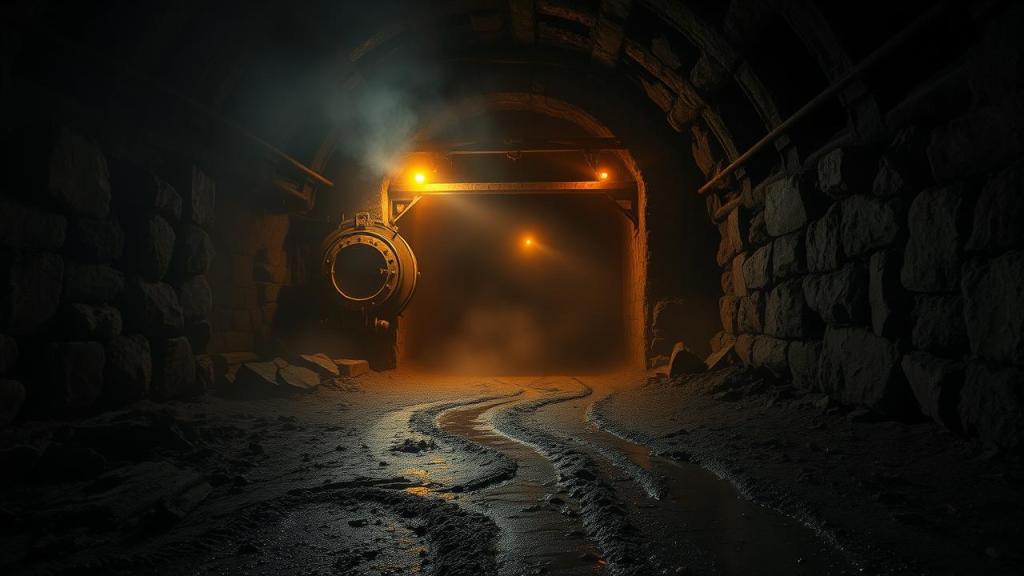
| DOCUMENT TYPE: PARANORMAL FIELD INVESTIGATION REPORT | DOC-ID: ARC-1962-4817 |
| CLASSIFICATION: TOP SECRET // NOFORN | ARCHIVE DATE: 1963.09.02 |
| LEAD RESEARCHER: Dr. K. Novotná, Charles University Prague | INCIDENT SITE: Stříbro District, Bohemia, ČSSR — 49°45’N 12°53’E |
▌ ENGLISH SECTION — PRIMARY DOCUMENTATION
I. BACKGROUND & GEOGRAPHIC CONTEXT
The Stříbro mining district, situated in the Tachov region of western Bohemia (Czechoslovak Socialist Republic), has been the site of continuous silver extraction since the twelfth century. By 1962, the district was administered under the nationalized enterprise Příbramské uranové doly, n.p., which had extended operations from silver and tin ore into uranium prospecting. The workforce comprised approximately 340 registered employees across three active shaft complexes: Šachta Václav I, Šachta Václav II, and the more recently excavated Šachta Prokop. The surrounding settlement of Stříbro proper maintained a civilian population of 7,200 residents, the majority of whom were either directly or indirectly employed by the state mining enterprise. It is within this concentrated and socially isolated community that the anomalous events of January–February 1962 were documented and subsequently classified under Ministerstvo vnitra directive NV-7/62-B.
II. PHENOMENOLOGICAL DESCRIPTION OF THE DISPLACEMENT EVENTS
Between January 14 and February 19, 1962, a total of thirty-four individuals reported experiencing episodes of involuntary sensory and environmental displacement, subsequently classified by lead investigator Dr. Kateřina Novotná as Temporal Fugue Events (TFEs). Subjects described the onset as an abrupt cessation of ambient sound followed by a replacement of the immediate visual field with scenes consistent with the Stříbro district as it appeared circa 1931–1935. Specific recurring elements across multiple unrelated accounts included: the observation of horse-drawn supply carts of pre-war design traveling along Ulice Prokopa Velikého; auditory perception of German-language commercial exchange at market stalls that no longer existed in 1962; and the sensation of dry summer heat occurring despite the documented January ambient temperature of −9°C. Subjects universally reported the experience as indistinguishable from waking reality for the duration of the event. Abrupt termination of the fugue state was in most cases associated with a physical impact event — subjects colliding with fixed objects, walls, or machinery — as though the perceptual overlay had temporarily suppressed awareness of actual surroundings.
The duration of individual events ranged from four minutes to a maximum of two hours and seventeen minutes, the latter case involving mine foreman Antonín Blaha (subject designation: TFE-09), who was subsequently found by colleagues in a disoriented state in Šachta Prokop’s Level 4 access corridor, having traversed approximately 340 meters through active mining works without conscious awareness. Blaha reported that during the event he was walking through an open agricultural field, speaking with an elderly man he later identified from archival photographs as Jaroslav Šimek, a Stříbro grain merchant who had died in 1944.
III. STATE INVESTIGATION — CZECHOSLOVAK PARAPSYCHOLOGICAL RESEARCH INSTITUTE
Following the third major incident on February 19, 1962 — during which eleven workers simultaneously reported displacement events while ascending Šachta Václav II’s primary lift cage — the district management submitted a formal incident report to the Czechoslovak Ministry of the Interior. The report was routed within 72 hours to the Special Phenomena Assessment Division (Oddělení zvláštních jevů, or OZJ) of the Czechoslovak Parapsychological Research Institute in Brno, a sub-department operating under the formal designation of the Institute of Experimental Psychology, Charles University Prague, as a cover for internal state security purposes. Dr. Kateřina Novotná (born 1928, Prague), a specialist in mass psychogenic illness and altered consciousness research, was assigned as lead investigator on February 26, 1962, accompanied by two field assistants: Ing. Pavel Dvořáček and Dr. Maria Sedláčková.
The investigation team spent eleven weeks conducting standardized interviews with all thirty-four subjects, administering neurological assessments, reviewing safety records, and performing geophysical measurements within the shaft complexes. A key finding of the field survey was the detection of anomalous low-frequency acoustic resonance emanating from a previously unmapped sub-level cavity beneath the floor of Šachta Prokop’s Level 4 corridor — precisely the area in which the majority of high-duration TFEs had been reported. Resonance measurements recorded by Ing. Dvořáček ranged from 0.3 to 2.1 Hz, overlapping with the infrasound frequency range known to produce hallucinatory and dissociative effects in human subjects. However, Dr. Novotná noted in her primary report (Document OZJ-62-14b) that the acoustic explanation, while consistent with isolated hallucination, was insufficient to account for the high degree of cross-subject narrative convergence, given that thirty-one of thirty-four subjects had independently described the same recurring pre-war horse-cart and market scene without prior consultation.
IV. NEUROLOGICAL & PSYCHOPHYSIOLOGICAL ANALYSIS
Neurological assessments conducted by Dr. Sedláčková revealed no structural abnormalities in any of the thirty-four subjects. Electroencephalographic readings taken from five subjects within 24 hours of a reported TFE showed prolonged theta-wave dominance in the parietal and temporal lobes inconsistent with a standard waking state, but insufficient to indicate epileptiform activity. Blood toxicology panels, conducted discreetly through the district health clinic under the pretext of routine occupational health screening, returned no significant anomalies. Radon gas levels within the mine shafts were measured and found to exceed WHO advisory thresholds in the Level 3 and Level 4 sections of Šachta Prokop, with a peak reading of 3,800 Bq/m³. While chronic radon exposure is documented to produce neurological fatigue and cognitive impairment, the OZJ team could not establish a direct causal mechanism linking radon concentration levels to the specific phenomenology of the reported experiences.
Dr. Novotná’s final assessment, submitted October 4, 1962, classified the events under provisional Category III — defined in OZJ internal taxonomy as a “multi-subject perceptual anomaly of undetermined etiology, not conclusively attributable to known physiological, chemical, or psychological mechanisms.” The document was sealed under Ministerstvo vnitra directive NV-7/62-B and withheld from publication until the partial declassification of Czechoslovak paranormal research archives in 1993. No further official investigation was conducted at the site after the mine shaft Prokop was closed in 1967 citing structural instability.
V. ADDENDUM — 1964 FOLLOW-UP ASSESSMENT
A restricted follow-up assessment was conducted in August 1964 by Ing. Dvořáček following reports that three former TFE subjects — none of whom had remained employed at the mine after May 1962 — reported recurrent brief displacement episodes in their domestic residences. Subject TFE-03 (female, age 44, laundry worker) reported a 12-minute episode during which she observed and interacted with an individual subsequently identified from family photographs as her deceased mother-in-law, who had died in Stříbro in 1938. Subject TFE-09 (Antonín Blaha) reported two further episodes of the pre-war market scene, now absent the previously observed elderly merchant. Subject TFE-21 (male, age 29, underground engineer) reported no further episodes but exhibited persistent temporal disorientation, frequently misidentifying the current year as 1934 during periods of physical exhaustion. Dvořáček’s follow-up report, designated OZJ-64-03c, recommended indefinite surveillance of all primary subjects. The current status of the surveillance program is not reflected in declassified materials.
◆ FIELD DATA / INCIDENT LOG
EVENT 01 — 1962.01.14 · Šachta Václav I, Level 2 · Subjects: 4 · Duration: 4–22 min · Shared element: pre-war market street scene
EVENT 02 — 1962.02.03 · Šachta Prokop, Level 4 · Subjects: 7 · Duration: 11–137 min · Shared element: horse-cart + German-language exchange
EVENT 03 — 1962.02.19 · Šachta Václav II, primary lift cage · Subjects: 11 · Duration: 6–44 min · Simultaneous group onset documented
ISOLATED REPORTS — 1962.01–02 · Civilian addresses, Stříbro town center · Subjects: 12 · Duration: 4–19 min
TOTAL PRIMARY SUBJECTS: 34 · TOTAL SECONDARY OBSERVERS: 11
INFRASOUND READINGS (Šachta Prokop L4): 0.3–2.1 Hz · RADON LEVELS: up to 3,800 Bq/m³
CROSS-SUBJECT NARRATIVE CONVERGENCE: 31/34 subjects (91.2%) independently described identical pre-war market scene
FINAL CLASSIFICATION: Category III — Undetermined Etiology · Status: SEALED (NV-7/62-B)
▌ 한국어 섹션 — 기밀 번역 문서
I. 배경 및 지리적 맥락
서보헤미아 타호프 지역에 위치한 슈트르지브로(Stříbro) 광산 지구는 12세기부터 지속적인 은 채굴이 이루어진 역사적 요지로, 1962년 당시 체코슬로바키아 사회주의 공화국(ČSSR) 국영 기업인 프르지브람 우라늄 광업 공사(Příbramské uranové doly, n.p.) 관할 하에 있었다. 이 시기 광산 구역은 은·주석 채굴에서 우라늄 탐사로 사업 영역을 확장하였으며, 바츨라프 1·2호 갱도와 프로코프 갱도 등 세 개의 주요 수직갱을 중심으로 약 340명의 등록 노동자가 종사하고 있었다. 인근 슈트르지브로 시가지에는 약 7,200명의 민간 주민이 거주하였고, 대부분은 국영 광업체와 직간접적 고용 관계에 있었다. 이처럼 폐쇄적이고 집약적인 공동체 속에서 1962년 1월부터 2월 사이에 발생한 일련의 이상 현상은 내무부 지침 NV-7/62-B에 의거하여 즉각 기밀로 분류되었다.
II. 시간 이탈 사건의 현상학적 기술
1962년 1월 14일부터 2월 19일 사이, 총 34명의 개인이 비자발적 감각·환경 전이 경험을 보고하였다. 수석 조사관 카테르지나 노보트나(Kateřina Novotná) 박사는 이를 ‘시간적 이탈 사건(Temporal Fugue Events, TFE)’으로 분류하였다. 피험자들은 발현 과정에서 공통적으로 주변 소음이 갑작스럽게 사라지고, 즉각적인 시각장이 1931~1935년경의 슈트르지브로 시가지 풍경으로 대체되는 경험을 보고하였다. 서로 무관한 복수의 진술에서 반복적으로 등장하는 세부 요소로는 프로코파 벨리케호 거리(Ulice Prokopa Velikého)를 따라 이동하는 전전(戰前) 양식의 마차, 1962년 현재 존재하지 않는 노점에서 이루어지는 독일어 상거래 소리, 그리고 당시 실측 기온 영하 9도와 상충되는 건조한 여름 더위의 감각 등이 포함된다. 피험자들은 공통적으로 이 경험이 사건 지속 시간 동안 완전히 현실과 구별 불가능하였다고 진술하였다.
개별 사건의 지속 시간은 최단 4분에서 최장 2시간 17분에 달하였다. 최장 사례는 광산 감독관 안토닌 블라하(Antonín Blaha, 피험자 번호 TFE-09)로, 그는 프로코프 갱도 제4수준 접근 통로에서 약 340미터를 무의식 상태로 이동한 채 동료들에 의해 발견되었다. 블라하는 사건 당시 자신이 개방된 농경지를 걷고 있었으며, 이후 기록 사진을 통해 1944년 사망한 슈트르지브로 출신 곡물 상인 야로슬라프 시메크(Jaroslav Šimek)로 확인된 노인과 대화를 나누었다고 진술하였다.
III. 국가 조사 — 체코슬로바키아 초심리학 연구소 (OZJ)
1962년 2월 19일, 바츨라프 2호 갱도 주 승강기에 탑승한 11명의 노동자가 동시에 TFE를 경험한 세 번째 주요 사건 이후, 지구 관리부는 내무부에 공식 사건 보고서를 제출하였다. 보고서는 72시간 내에 브르노 소재 체코슬로바키아 초심리학 연구소(Czechoslovak Parapsychological Research Institute) 산하 특수현상평가부(Oddělení zvláštních jevů, OZJ)로 회부되었다. 이 부서는 카를대학교 실험심리학 연구소라는 명목 기관으로 대외에 공개되었으나, 실질적으로는 국가보안 목적의 비공개 조직이었다. 수석 조사관으로는 카를대학교 소속으로 집단 심인성 질환과 의식 변형 연구를 전문으로 하는 카테르지나 노보트나 박사(1928년 프라하 출생)가 임명되었으며, 파벨 드보르체크(Pavel Dvořáček) 기술사와 마리아 세들라치코바(Maria Sedláčková) 박사가 현장 보조원으로 동행하였다.
조사팀은 11주에 걸쳐 전체 34명의 피험자를 면담하고, 신경학적 평가를 실시하며, 갱도 내 지구물리학적 측정을 수행하였다. 현장 조사의 핵심 발견은 대부분의 고지속 TFE가 보고된 프로코프 갱도 제4수준 통로 하부에 존재하는, 기존 지도에 등재되지 않은 공동(空洞)에서 발생하는 이상 저주파 음향 공명이었다. 드보르체크 기술사가 측정한 공명 수치는 0.3~2.1 Hz로, 인간에게 환각 및 해리 효과를 유발하는 것으로 알려진 초저주파음 범위와 일치하였다. 그러나 노보트나 박사는 1차 보고서(문서 OZJ-62-14b)에서 음향학적 설명이 개별 환각에는 부합하더라도, 34명 중 31명이 사전 상의 없이 동일한 전전 시장 장면을 독립적으로 기술한 높은 수준의 서사적 수렴 현상을 충분히 설명하지 못한다고 지적하였다.
IV. 신경학적·심리생리학적 분석
세들라치코바 박사가 실시한 신경학적 평가에서 34명의 피험자 모두 구조적 이상이 발견되지 않았다. TFE 보고 후 24시간 이내에 5명의 피험자로부터 채취한 뇌파 검사(EEG) 결과, 두정엽과 측두엽에서 일반적인 각성 상태와 상충되는 지속적 세타파(theta wave) 우세가 관찰되었으나, 간질성 전기 활동의 징후는 나타나지 않았다. 직업 건강 검진을 명목으로 지역 병원을 통해 비공개 방식으로 실시된 혈액 독성 검사에서도 유의미한 이상은 발견되지 않았다. 갱도 내 라돈 가스 농도는 프로코프 갱도 제3·4수준에서 세계보건기구(WHO) 권고 기준을 초과하여 최고 3,800 Bq/m³까지 측정되었다. 만성 라돈 노출이 신경학적 피로와 인지 장애를 유발하는 것은 의학적으로 기록된 사실이나, OZJ 조사팀은 라돈 농도와 보고된 경험의 특정 현상 사이의 직접적 인과 메커니즘을 확립할 수 없었다.
1962년 10월 4일 제출된 노보트나 박사의 최종 평가서는 본 사건들을 OZJ 내부 분류 기준 카테고리 III — ‘기지(旣知)의 생리적·화학적·심리적 메커니즘으로 결론적으로 귀인할 수 없는, 미결 병인의 다중 피험자 지각 이상 현상’ — 으로 잠정 분류하였다. 해당 문서는 내무부 지침 NV-7/62-B에 의거하여 봉인되었으며, 1993년 체코슬로바키아 초자연 연구 기록물이 부분 공개될 때까지 일반에 공개되지 않았다. 프로코프 갱도는 1967년 구조적 불안정을 이유로 폐쇄되었으며, 이후 공식적인 현장 조사는 실시되지 않았다.
V. 부록 — 1964년 추적 조사
1964년 8월, 드보르체크 기술사는 1962년 5월 이후 광산을 떠난 전직 TFE 피험자 세 명이 자택에서도 산발적 이탈 경험을 지속 보고한다는 제보를 접수하고 제한적 추적 조사를 실시하였다. TFE-03(여성, 44세, 세탁 노동자)은 12분간 자신의 1938년 사망한 시어머니와 상호작용하는 경험을 보고하였으며, 해당 인물은 이후 가족 사진을 통해 신원이 확인되었다. TFE-09(안토닌 블라하)는 전쟁 전 시장 장면을 두 차례 더 경험하였으나, 이전과 달리 노인 상인은 나타나지 않았다. TFE-21(남성, 29세, 지하 엔지니어)은 추가 이탈 경험은 보고하지 않았으나, 육체적 피로 상태에서 반복적으로 현재 연도를 1934년으로 잘못 인지하는 지속적 시간 지남력 장애를 보였다. OZJ-64-03c로 지정된 드보르체크의 추적 보고서는 모든 주요 피험자에 대한 무기한 감시를 권고하였으며, 공개 자료에서는 해당 감시 프로그램의 현재 상태가 확인되지 않는다.
◆ 현장 데이터 / 사건 기록
사건 01 — 1962.01.14 · 바츨라프 1호 갱도 제2수준 · 피험자: 4명 · 지속: 4~22분 · 공통 요소: 전전(戰前) 시장 거리 장면
사건 02 — 1962.02.03 · 프로코프 갱도 제4수준 · 피험자: 7명 · 지속: 11~137분 · 공통 요소: 마차 + 독일어 상거래 소음
사건 03 — 1962.02.19 · 바츨라프 2호 갱도 주 승강기 · 피험자: 11명 · 지속: 6~44분 · 최초 동시 집단 발현 기록
산발 보고 — 1962.01~02 · 슈트르지브로 시가지 민간 주거지 · 피험자: 12명 · 지속: 4~19분
1차 피험자 총계: 34명 · 2차 목격자 총계: 11명
초저주파 측정치 (프로코프 갱도 L4): 0.3~2.1 Hz · 라돈 농도: 최고 3,800 Bq/m³
피험자 간 서사 수렴률: 34명 중 31명(91.2%)이 동일한 전전 시장 장면 독립 기술
최종 분류: 카테고리 III — 병인 미결 · 현황: 기밀 봉인 (NV-7/62-B)
THIS DOCUMENT IS CLASSIFIED — UNAUTHORIZED ACCESS IS PROHIBITED
본 문서는 기밀 자료입니다 — 무단 열람은 엄격히 금지됩니다

