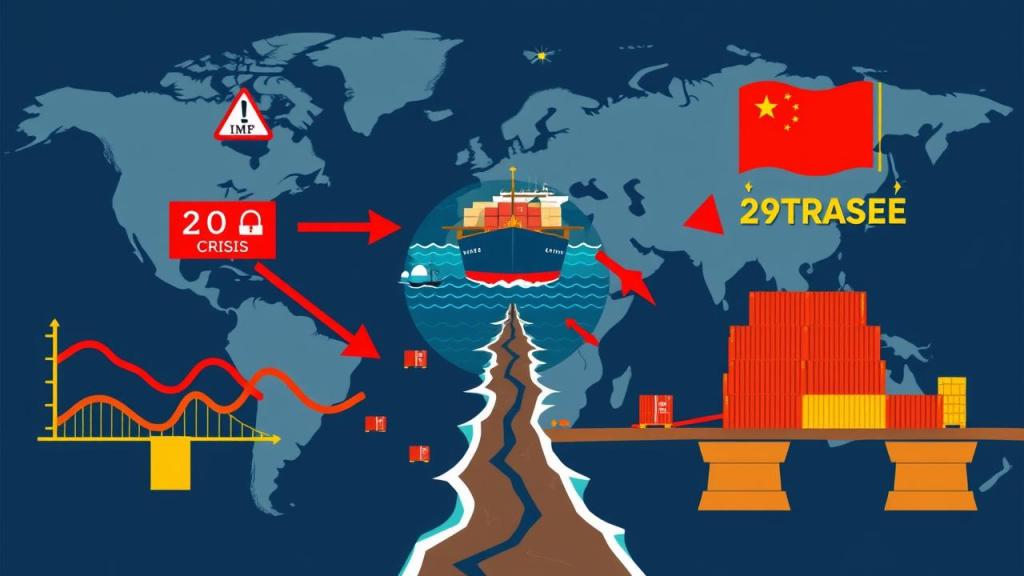
🌐 Global Economy Briefing — April 19, 2026
A war-shadowed global economy is facing its most severe energy shock in decades, as Middle East conflict chokes the Strait of Hormuz and sends Brent crude prices soaring toward record territory. The IMF has sharply downgraded its global growth forecast, warning that persistent inflation, tightening financial conditions, and fragile trade networks are converging into a dangerous cocktail — one that threatens commodity-importing nations most of all, while US equity markets reel and the Europe-China trade relationship fractures further under the strain.
🛢️ Hormuz Blockade Triggers Historic Oil Supply Collapse
🔥 Biggest Supply Disruption Ever Recorded
Global oil supply plummeted by 10.1 million barrels per day in March — the single largest supply disruption in the history of energy markets — as attacks on infrastructure and tanker blockades at the Strait of Hormuz cut off a critical artery of world trade.
📰 A Chokepoint That Controls the World’s Energy Lifeline
The Strait of Hormuz carries roughly 20% of global oil trade, and sustained disruptions there instantly transmit price shocks worldwide. Production shut-ins averaged 7.5 million barrels per day through March and are expected to peak at 9.1 million b/d in April, before gradually easing as diplomatic and military responses take shape. The conflict has reignited fears of a 1970s-style stagflationary episode.
📊 KEY DATA
▸ Global oil supply fell 10.1 mb/d to 97 mb/d in March ▸ Brent crude averaged $103/b in March, peaked near $128/b on April 2 ▸ Q2 2026 Brent price forecast: $115/b (IEA) ▸ Global oil demand now projected to decline 80 kb/d in 2026 vs. +730 kb/d expected prior to crisis ▸ Production shut-ins peak: 9.1 mb/d (April 2026)
🌍 Commodity Importers Bear the Brunt Globally
Energy-importing economies across South Asia, Sub-Saharan Africa, and Southeast Asia face surging import bills that are draining foreign reserves and forcing central banks into painful rate choices. Fertilizer and shipping costs are also spiking alongside oil, threatening food security in vulnerable nations. European industrial competitiveness is further undermined as energy costs rise at a moment when the continent is already struggling for growth momentum.
👁 WHAT TO WATCH
Monitor IEA emergency reserve release decisions (expected late April), any ceasefire or diplomatic progress through UN-mediated talks, and whether OPEC+ members outside the conflict zone increase compensatory output. The next IEA Oil Market Report is due mid-May 2026.
🎙 EXPERT TAKE
“The scale and speed of this disruption exceeds anything we modeled for the Hormuz scenario — we are in uncharted territory for energy markets,” noted the IEA in its April 2026 Oil Market Report. J.P. Morgan Global Research has revised its oil price forecast sharply upward, projecting sustained elevated prices through mid-2026 (J.P. Morgan, April 2026).
💡 Energy Security Is Now the World’s Defining Economic Crisis
For consumers and governments alike, the Hormuz blockade is a stark reminder that modern economies remain hostage to a handful of geographic chokepoints — and the cost of that vulnerability is now appearing on every fuel receipt and inflation dashboard worldwide.
🌐 IMF Slashes Growth Forecast Under War’s Long Shadow
🔥 Global Growth Falls to 3.1% — Well Below Pre-Pandemic Norms
The IMF’s April 2026 World Economic Outlook, titled “Global Economy in the Shadow of War,” has cut its global growth projection to just 3.1% for 2026 — a significant step down from recent outturns and far below the pre-pandemic average of around 3.8%.
📰 Three Scenarios, All of Them Uncomfortable
The IMF’s reference case assumes a limited, short-lived conflict with energy prices rising 19% on average in 2026. But it also presents an adverse scenario (growth 2.5%, inflation 5.4%) and a severe scenario (growth 2.0%, inflation above 6%), reflecting deep uncertainty about the conflict’s duration and spread. Policymakers are caught between the need to fight inflation and the risk of strangling fragile recoveries with tighter monetary policy.
📊 KEY DATA
▸ Global growth forecast 2026: 3.1% (IMF, April 2026) ▸ Global headline inflation forecast: 4.4% (+0.6 pts vs. prior outlook) ▸ Adverse scenario: growth 2.5%, inflation 5.4% ▸ Severe scenario: growth 2.0%, inflation 6%+ ▸ Energy price rise assumption (reference): +19% in 2026
🌍 Emerging Markets Face a Perfect Storm of Pressures
The IMF specifically flags emerging market and developing economies — particularly commodity importers with pre-existing fiscal vulnerabilities — as the most exposed to the dual threat of higher energy prices and tighter global financial conditions. Capital outflows, currency pressure, and rising debt service costs are compounding the shock for countries in South Asia, Latin America, and Sub-Saharan Africa.
👁 WHAT TO WATCH
The IMF and World Bank Spring Meetings (April 2026) will shape the international policy response. Watch for coordinated central bank guidance at May FOMC, ECB, and Bank of England meetings, as well as any new emergency IMF lending facility announcements for the most vulnerable developing nations.
🎙 EXPERT TAKE
“War darkens the outlook not just through energy prices, but through uncertainty itself — businesses delay investment, households cut spending, and risk premiums rise globally,” wrote the IMF’s chief economist in the April 2026 WEO blog. Seeking Alpha’s April 2026 analysis echoed this: “The fog of war has replaced the fog of inflation as the central challenge for global policymakers.”
💡 The World Economy Has Traded One Crisis for Another
Just as global inflation was finally retreating toward target, the Middle East conflict has reset the clock — forcing central banks, governments, and investors to once again navigate a high-uncertainty, high-inflation environment with far less policy space than before.
🇺🇸 US Markets Wobble as Magnificent Seven Stumble
🔥 Tech Giants Shed 12% as Geopolitical Risk Bites Wall Street
America’s most celebrated stock market darlings — the “Magnificent Seven” mega-cap tech stocks — have collectively fallen approximately 12% year-to-date in 2026, with Microsoft, Tesla, Apple, and Alphabet all posting double-digit losses as energy shocks, geopolitical uncertainty, and slowing consumer sentiment weigh on investor confidence.
📰 Fed Stays Patient as Inflation Risks Re-Emerge
The Federal Reserve, which cut rates by 1.75 percentage points between mid-2024 and early 2026, now faces a dilemma: inflation is re-accelerating on the back of energy prices while labor markets are cooling only gradually. The Fed is expected to proceed cautiously, delivering just two 25-basis-point cuts in September and December 2026 — a far cry from the aggressive easing markets had hoped for at the start of the year.
📊 KEY DATA
▸ Magnificent Seven YTD performance: –12% ▸ S&P 500 large-cap P/E: ~19.5x (down from ~25x at year-start) ▸ Fed Funds Rate: 3.50–3.75% ▸ Expected 2026 Fed cuts: 50 bps total (Sep + Dec) ▸ S&P 500 earnings growth forecast 2026: ~16% ▸ S&P 400 mid-cap earnings growth: +19.6%
🌍 Dollar Strength Squeezes Emerging Market Borrowers
With the Fed likely on hold longer than expected, the US dollar remains elevated, amplifying debt burdens for emerging market economies with dollar-denominated obligations. Tighter global financial conditions are rippling outward from Wall Street, increasing borrowing costs for sovereign and corporate issuers across Latin America, Southeast Asia, and Africa at exactly the moment they need fiscal space to absorb the energy shock.
👁 WHAT TO WATCH
Q1 2026 earnings season is now underway — results from remaining Magnificent Seven members will be closely scrutinized for guidance on AI investment spending and consumer demand. The next FOMC meeting (May 2026) will provide clearer signals on the Fed’s tolerance for inflation re-acceleration.
🎙 EXPERT TAKE
“Mid- and small-cap companies are emerging as the real winners of this market rotation — they’re less exposed to geopolitical headlines and more tied to domestic economic resilience,” noted Mutual of America’s April 2026 Economic & Market Perspective. Loomis Sayles’ April 2026 Investment Outlook flagged that S&P 400 and 600 earnings growth projections remain robust at 19.6% and 15.6% respectively.
💡 The Era of Tech-Led Market Dominance May Be Rotating
As mega-cap tech faces headwinds from geopolitics, valuation resets, and a more cautious Fed, investors are rediscovering the value of diversification — and the mid-cap rotation now underway may signal a more durable, broad-based market structure ahead.
🇪🇺 🇨🇳 China-Europe Trade Rift Deepens into Structural Divide
🔥 €360 Billion Deficit Exposes Europe’s China Dependency
The EU’s trade deficit with China has ballooned to €359.8 billion — a staggering imbalance that is fueling political tension in Brussels and raising urgent questions about European industrial survival, fair competition, and strategic autonomy in the face of Chinese overcapacity.
📰 Overcapacity Exports Deflation — and Unemployment — to Europe
China’s domestic demand remains stubbornly weak, leading manufacturers to redirect surplus production into export markets at rock-bottom prices. This is compressing margins for European manufacturers competing in both domestic and third-country markets, sparking fears of industrial decline and mass unemployment across Germany, France, and Southern Europe. The EU is struggling to agree on a coherent policy response that balances trade protection with the need to maintain diplomatic and economic ties with Beijing.
📊 KEY DATA
▸ EU exports to China: €199.6B (–6.5% vs. 2024) ▸ EU imports from China: €559.4B (+6.4% vs. 2024) ▸ EU-China trade deficit: €359.8B ▸ China 2026 GDP growth forecast: 4.4% (IMF/World Bank) ▸ EU growth forecast 2026: ~1% overall; Germany 1% (Merz plan), France 0.6%
🌍 A Bifurcating World Trade System Takes Shape
The growing EU-China rift is accelerating the fragmentation of global trade into competing blocs — with Southeast Asian nations caught in the middle as alternative manufacturing hubs, and developing nations forced to navigate competing supply chain allegiances. For global trade as a whole, UNCTAD’s April 2026 Global Trade Update warns that growth will slow in the second half of the year as trade tensions and rising costs bite.
👁 WHAT TO WATCH
Watch for EU anti-subsidy investigation outcomes on Chinese electric vehicles and solar panels (rulings expected Q2–Q3 2026), and whether Germany’s Merz government takes a harder line in bilateral trade negotiations with Beijing. China’s Q1 2026 GDP data, due late April, will clarify whether the domestic demand weakness is structural or cyclical.
🎙 EXPERT TAKE
“Europe faces an impossible triangle: it needs Chinese markets for exports, Chinese supply chains for manufacturing, and protection from Chinese competition — it cannot have all three,” according to Coface’s April 2026 European Business Outlook. Deutsche Bank’s China 2026 Blueprint analysis noted that Beijing will prioritize export-led stability over domestic demand stimulus in the near term (Deutsche Bank, March 2026).
💡 Europe Must Choose Between Access and Autonomy
The EU’s ballooning China deficit is no longer just a trade statistic — it is a strategic vulnerability, and Brussels is running out of time to decide whether deeper decoupling or managed interdependence is the less painful path forward.
※ This content is automatically generated from public news sources. For reference only — not investment advice.

