| DOCUMENT TYPE: FIELD INVESTIGATION REPORT — PSYCHOACOUSTIC ANOMALY | DOC-ID: ARC-AURIS-2026-0426 |
| CLASSIFICATION: TOP SECRET // NOFORN // POLAR-EYES-ONLY | ARCHIVE DATE: 2026.04.26 |
| LEAD RESEARCHER: Dr. V. Mikhailov & Dr. L. Marchetti | INCIDENT SITE: 78°27′52″S, 106°50′14″E |
▌ ENGLISH SECTION — PRIMARY DOCUMENTATION
PHENOMENOLOGICAL OVERVIEW
The Vostok Station Auditory Drift Phenomenon (hereafter, AURIS-Δ) refers to a recurring perceptual anomaly documented intermittently between austral winter 1971 and austral winter 1989 at the Soviet polar research station Vostok, located on the East Antarctic ice sheet at an elevation of 3,488 meters. The phenomenon is characterized by the synchronous perception, by two or more isolated personnel, of a low-amplitude harmonic drone whose perceived spatial origin appears to translate slowly through the interior structure of the station — a behavior described in field notes as “drift.” Subjects consistently localize the source as moving along the longitudinal axis of the main residential corridor at a velocity averaging 0.4 to 0.7 meters per minute, regardless of the listener’s position within the building.
Audiometric instrumentation deployed during the 1976 and 1983 wintering seasons failed to register acoustic energy corresponding to subject testimony. Ambient sound pressure levels remained within nominal background ranges (28–34 dB SPL across the 20 Hz–20 kHz band) throughout each reported episode. The discrepancy between subjective experience and instrumental record forms the central evidentiary problem of the phenomenon and constitutes the primary justification for its classification under the AURIS designation.
ENVIRONMENTAL & GEOPHYSICAL CONTEXT
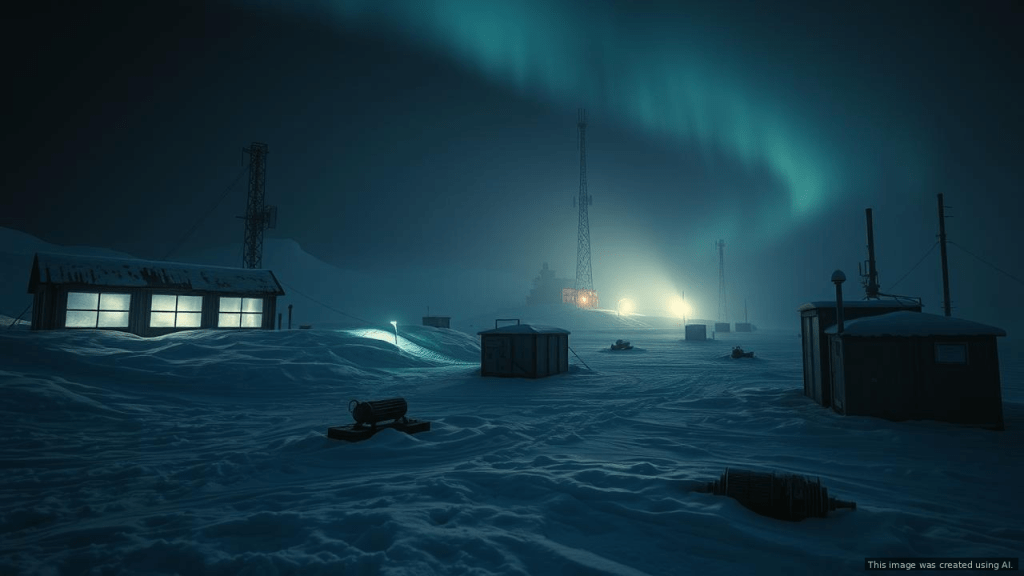
Vostok Station occupies a region of profound environmental austerity. Surface air temperatures during austral winter regularly fall below −80 °C, and the ambient atmosphere is among the driest on Earth. The station rests directly above subglacial Lake Vostok, a body of liquid water sealed beneath approximately 3,769 meters of glacial ice and isolated from the surface biosphere for an estimated 15–25 million years. Geomagnetic field strength at the station exhibits notable diurnal variability owing to its proximity to the Antarctic geomagnetic pole.
All recorded AURIS-Δ episodes occurred during the polar night, when continuous darkness, severe sensory deprivation, and prolonged social isolation are known to induce measurable changes in human auditory and cognitive processing. However, the phenomenon’s reported synchrony across non-adjacent subjects exceeds the parameters of solitary perceptual disturbance, and was repeatedly reproduced under blind separation protocols devised by Dr. Mikhailov beginning in 1979.
SUBJECT TESTIMONY & CROSS-CORRELATION
Across the eighteen-year monitoring period, fifty-seven distinct personnel filed AURIS-Δ-related observations in the station’s medical-psychological log. Of these, forty-one entries describe a “moving low tone” between approximately 18 Hz and 32 Hz; thirteen describe a “rhythmic pulsation” superimposed on the drone at periods of three to five seconds; three describe an apparent “vocal quality” — uniformly characterized as wordless, non-melodic, and devoid of identifiable affect.
Cross-correlation conducted in 1984 by Dr. L. Marchetti of the joint Italian–Soviet polar research exchange demonstrated that, in seven independently documented episodes, two or more subjects situated in non-communicating compartments produced spatially congruent localizations of the source — that is, both subjects independently described the perceived sound as currently passing through the same point in the station, despite having no means of coordination. The probability of coincidental agreement under standard psychoacoustic modeling was calculated at p < 0.0007.
ANALYSIS & CURRENT HYPOTHESES
Three principal hypotheses remain under consideration. The first attributes AURIS-Δ to infrasonic resonance generated by ice-shelf flexure and transmitted through the station’s foundation pylons; this model accounts for the perceived frequency band but fails to explain the absence of instrumentally measurable signal. The second posits a shared psychogenic response induced by uniform sensory deprivation, akin to a polar variant of mass hypochondrial perception; however, the statistical congruence of independent localizations remains unexplained under purely cognitive models. The third — designated the “non-acoustic transmission hypothesis” — proposes that the percept is generated within the auditory cortex itself by a stimulus of currently unknown nature, possibly geomagnetic or quantum-mechanical, that bypasses the cochlea.
No hypothesis presently accounts for the totality of observed data. Following the conclusion of the original Soviet program in 1991, the AURIS-Δ dossier was transferred to the Eastern Anomalies Branch and remains active under low-priority watch status. Recurrence has been logged on a degraded but continuous basis through the present archival year.
ONGOING DIRECTIVES
Wintering personnel at all Antarctic stations within a 600-kilometer radius of the original incident site are instructed to log any auditory perceptions of unaccountable origin in the standardized AURIS Form, copies of which are maintained in each station’s medical bay. Direct vocal communication regarding such perceptions between affected personnel is to be avoided during the active period to preserve the integrity of any future blind-separation analysis.
◆ FIELD DATA / INCIDENT LOG
▸ 1971.07.14 — First documented episode. Two meteorologists, residential corridor. Duration: 41 minutes.
▸ 1976.06.22 — First instrumented episode. Audiometric array negative. Five subjects affected. Duration: 2 h 18 min.
▸ 1979.08.03 — First successful blind-separation trial. Spatial congruence: 4 of 4 subjects.
▸ 1983.07.09 — Episode coincides with severe geomagnetic storm (K-index 8). Duration: 6 h 11 min.
▸ 1984.05.30 — Marchetti cross-correlation analysis completed. p < 0.0007.
▸ 1989.09.18 — Final episode of original monitoring period. Duration: 53 minutes. Subjects report perceived terminus at the station’s southwest exterior wall.
▸ 1991.12.04 — Dossier transferred to Eastern Anomalies Branch. Status: ACTIVE — LOW PRIORITY.
▌ 한국어 섹션 — 기밀 번역 문서
현상 개요
보스토크 기지 청각 표류 현상(이하 AURIS-Δ)은 1971년 남극 동절기부터 1989년 남극 동절기에 이르기까지 동남극 빙상 위 해발 3,488미터에 위치한 소비에트 극지 연구 기지 보스토크에서 단속적으로 기록된 반복성 지각 이상 현상을 지칭한다. 본 현상의 핵심적 특징은, 상호 격리된 둘 이상의 인원이 동시에 저진폭의 화성적 저음(harmonic drone)을 인지하며, 그 지각된 공간적 음원이 기지 내부 구조를 따라 서서히 이동하는 것으로 보고된다는 점이다. 현장 기록은 이를 “표류(drift)”로 명명하였다.
피험자들은 음원이 본관 거주 구역 복도의 종축(縱軸)을 따라 분당 평균 0.4~0.7미터의 속도로 이동하는 것으로 일관되게 정위(定位)하였으며, 이러한 정위는 청취자가 건물 내 어느 위치에 있는가와 무관하게 동일한 결과를 보였다. 그러나 1976년 및 1983년 월동대(越冬隊) 운용 기간 중 배치된 청각 계측 장비는 피험자 진술에 부합하는 음향 에너지를 단 한 번도 검출하지 못하였다. 환경 음압 수준은 보고된 모든 일화에서 정상 배경 범위(20Hz~20kHz 대역에서 28~34dB SPL)를 유지하였다.
환경적·지구물리학적 맥락
보스토크 기지가 위치한 환경은 지구상에서 가장 가혹한 자연 조건 중 하나로 분류된다. 남극 동절기 표면 기온은 −80℃ 이하로 빈번히 강하하며, 대기는 지구상에서 가장 건조한 영역에 속한다. 본 기지는 대륙 빙하 약 3,769미터 아래에 봉인된 빙하 호수 보스토크 위에 자리하며, 이 호수는 추정 1,500만 년에서 2,500만 년 동안 지표 생물권으로부터 격리된 액체 수괴(水塊)이다. 또한 본 기지는 남자기극(南磁極)에 인접하여, 지자기장 강도가 일주(日週)적으로 현저한 변동을 보이는 지점에 해당한다.
기록된 모든 AURIS-Δ 일화는 극야(極夜) 기간 중 발생하였다. 지속적인 어둠, 극심한 감각 박탈, 장기간의 사회적 고립이 인간 청각 및 인지 처리에 측정 가능한 변화를 유발한다는 점은 기왕에 알려진 바이다. 그러나 본 현상이 보이는 비인접 피험자 간 동기성(同期性)은 단독적 지각 교란의 범주를 초과하며, 1979년 미하일로프 박사가 도입한 맹검 분리 프로토콜 하에서도 반복적으로 재현되었다.
피험자 증언 및 교차 검증
18년에 걸친 감시 기간 동안 총 57명의 인원이 기지의 의무·심리 일지에 AURIS-Δ 관련 관찰을 기록하였다. 그중 41건은 약 18Hz에서 32Hz 사이의 “이동하는 저음”을 기술하였으며, 13건은 그 위에 중첩되는 3~5초 주기의 “율동적 박동”을 보고하였고, 3건은 외관상 “음성적 특질(vocal quality)”을 지닌 것으로 묘사하였다. 후자는 모두 무언적이고, 비선율적이며, 식별 가능한 정동(情動)을 결여한 것으로 일관되게 진술되었다.
1984년 이탈리아·소비에트 극지 공동 연구 교환 프로그램의 마르체티 박사가 수행한 교차 검증은, 독립적으로 기록된 7건의 일화에서 상호 통신이 차단된 격실에 위치한 둘 이상의 피험자가 음원의 위치를 공간적으로 합치된 형태로 정위하였음을 증명하였다. 즉, 두 피험자는 그들 사이에 어떠한 조정 수단도 존재하지 않았음에도, 인지된 음원이 현재 기지 내 동일한 지점을 통과하고 있다고 독립적으로 진술하였다. 표준 정신음향학 모형에 근거한 우연 일치 확률은 p < 0.0007로 산출되었다.
분석 및 현행 가설
현재 세 가지 주요 가설이 검토 중이다. 첫째는 빙붕(氷棚)의 굴곡 운동에 의해 생성된 초저주파 공명이 기지의 기초 지주(支柱)를 통해 전달된다는 모형으로, 이는 인지된 주파수 대역을 설명하나 계측 가능한 신호의 부재를 설명하지 못한다. 둘째는 균일한 감각 박탈 환경 하에서 발생하는 공유적 정신원성(精神原性) 반응이라는 가설로, 일종의 극지 변종 집단 신체화 지각으로 분류 가능하다. 그러나 독립적 정위 사이의 통계적 합치성은 순수한 인지 모형 하에서 여전히 설명되지 않는다.
셋째 가설, 명명상 “비음향적 전달 가설(non-acoustic transmission hypothesis)”은 해당 지각이 와우관(蝸牛管)을 우회하여 청각 피질 자체에서 직접 발생한 것으로 가정한다. 이때 자극의 본성은 현재 미지이며, 지자기적 또는 양자역학적 매개체일 가능성이 제기된다. 어떠한 단일 가설도 관측 자료의 총체를 설명하지 못한다. 1991년 원(原) 소비에트 프로그램의 종료 이후, AURIS-Δ 문서철은 동방 이상 현상국(Eastern Anomalies Branch)으로 이관되어 현재 저우선순위 감시 상태로 활성 유지 중이다.
지속 감시 지침
최초 사건 발생 지점으로부터 반경 600킬로미터 이내에 위치한 모든 남극 기지의 월동 인원은, 출처가 규명되지 않는 모든 청각적 지각을 표준화된 AURIS 양식에 기록하도록 지시받는다. 활성 기간 중 영향을 받은 인원 사이의 직접적 음성 의사소통은, 차후 맹검 분리 분석의 무결성을 보존하기 위하여 회피하여야 한다.
◆ 현장 데이터 / 사건 기록
▸ 1971.07.14 — 최초 기록 일화. 기상학자 2인, 거주 구역 복도. 지속: 41분.
▸ 1976.06.22 — 최초 계측 일화. 청각 계측 어레이 음성(陰性). 영향 인원 5명. 지속: 2시간 18분.
▸ 1979.08.03 — 최초 맹검 분리 시험 성공. 공간 합치성: 4/4명.
▸ 1983.07.09 — 일화가 강도 높은 지자기 폭풍과 일치(K-지수 8). 지속: 6시간 11분.
▸ 1984.05.30 — 마르체티 교차 검증 분석 완료. p < 0.0007.
▸ 1989.09.18 — 원 감시 기간 최종 일화. 지속: 53분. 피험자들은 인지된 음원의 종착점을 기지 남서측 외벽으로 보고.
▸ 1991.12.04 — 문서철, 동방 이상 현상국으로 이관. 상태: 활성 — 저우선순위.
THIS DOCUMENT IS CLASSIFIED — UNAUTHORIZED ACCESS IS PROHIBITED
본 문서는 기밀 자료입니다 — 무단 열람은 엄격히 금지됩니다

