🌐 Global Economy Briefing — 2026-04-25
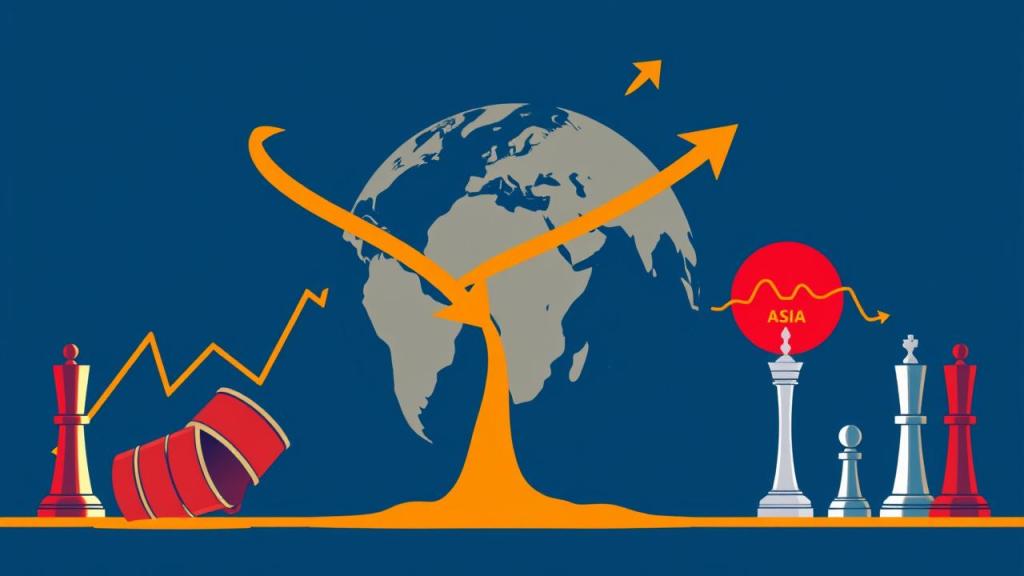
The world economy is being stress-tested by a Middle East war that has rewired commodity flows, lifted inflation forecasts, and forced central banks back into defensive mode. The IMF’s spring outlook this month cut global growth to 3.1% as oil pushed past $100, China dialed back ambition to a stability-first agenda, and emerging Asia absorbed the brunt of the energy shock. The mood at the Spring Meetings was unmistakable: resilience is fraying, and the policy room is shrinking.
🌍 IMF Slashes Global Growth as War Reshapes Outlook
🔥 Growth Forecast Cut to 3.1% in War Shadow
The IMF’s April 2026 World Economic Outlook downgraded global growth to 3.1% this year, well under the prepandemic average and a sharp reset from the 3.4% pace seen in 2025. The Fund titled its report “Global Economy in the Shadow of War” — and meant it.
📰 From Resilience to Strain in Six Months
Just months ago the global economy looked surprisingly resilient. The Middle East conflict that erupted earlier this year has reversed that narrative, pushing commodity prices higher, hardening inflation expectations, and tightening financial conditions across both advanced and emerging economies. The Fund explicitly assumes only a “limited conflict” in its baseline — meaning the actual outcome could be worse.
📊 KEY DATA
▸ Global growth 2026: 3.1% (vs 3.4% in 2025) ▸ 2027 projection: 3.2% ▸ Headline inflation 2026: 4.4% ▸ Adverse scenario inflation: 5.4% ▸ Largest downgrades hit Middle East and energy-importing Asia and Western Europe
🌍 Energy Importers Pay the Steepest Bill
The pain is concentrated where it hurts most: emerging-market commodity importers with preexisting fiscal vulnerabilities. Western European economies dependent on imported gas and Asian energy importers are facing the largest downward revisions, while commodity exporters get a partial windfall offset by weaker external demand.
👁 WHAT TO WATCH
The G20 finance ministers’ communiqué from the Spring Meetings, the IMF’s July WEO update, and any escalation that would invalidate the Fund’s “limited conflict” assumption — particularly tanker traffic data from the Strait of Hormuz.
🎙 EXPERT TAKE
“The global economy is being tested again, and the tools to respond are more limited than they were in past crises,” IMF chief economist remarks at the Spring Meetings press briefing, April 14, 2026. Goldman Sachs strategists have flagged that downside risks dominate the current forecast distribution.
💡 The Disinflation Era Has Quietly Ended
For the first time in three years, central banks face rising inflation alongside slowing growth — the textbook stagflation cocktail policymakers hoped to avoid.
🛢 Oil Smashes Through $100 on Strait of Hormuz Squeeze
🔥 Brent Crude Tops $103 — $37 Higher Than a Year Ago
Brent settled at $103.67 a barrel on April 23, marking a roughly $37.50 jump from the same period last year. Forecasters at the EIA expect prices to peak near $115 in the second quarter before easing toward $88 by year-end.
📰 The Largest Supply Disruption on Record
Continued attacks on Middle East energy infrastructure and restrictions on tanker movements through the Strait of Hormuz triggered the biggest oil supply disruption in history. Global supply collapsed by 10.1 million barrels per day in March, dropping to roughly 97 mb/d.
📊 KEY DATA
▸ Brent crude: $103.67 ▸ Q2 peak forecast: $115/b ▸ Q4 forecast: $88/b ▸ Supply drop in March: -10.1 mb/d ▸ European gas prices up 98% since the conflict began
🌍 Energy Inflation Goes Global, Fast
European gas prices have nearly doubled because roughly 20% of global LNG transits the Strait of Hormuz. The shock is rippling through shipping costs, food prices, and semiconductor input chains, hitting Asia’s energy-importing economies hardest.
👁 WHAT TO WATCH
OPEC+ output guidance at the next monitoring meeting, US strategic reserve releases, and any extension of the April 7 ceasefire — which already triggered one short-lived oil pullback and equity rally.
🎙 EXPERT TAKE
The Dallas Fed warns that closing the Strait of Hormuz for one, two or three quarters would lift U.S. headline PCE inflation by 0.35, 0.79 and 1.47 percentage points respectively in 2026 (Dallas Fed Working Paper 2609, April 2026).
💡 Energy Independence Is Back on Every Agenda
What looked like a 2022-era debate has returned with full force — every importer is now reassessing strategic reserves, LNG contracts, and renewables timelines.
🇺🇸 Fed Holds at 3.50–3.75% as Inflation Risks Re-emerge
🔥 Magnificent Seven Down 12% as Patience Becomes Policy
The Magnificent Seven mega-caps are off roughly 12% year-to-date, with Microsoft, Tesla, Apple and Alphabet all down double digits. The Fed is signaling patience — markets now expect just 50 basis points of cuts in 2026, penciled in for September and December.
📰 Two Years of Easing Meets a New Inflation Wave
Since August 2024 the Fed has trimmed rates 175 basis points, from 5.25–5.50% to today’s 3.50–3.75% range. But the Iran conflict has revived stagflation memories — energy, shipping, food and semiconductor input costs are all surging at once, pushing the Fed into a wait-and-see posture.
📊 KEY DATA
▸ Fed funds: 3.50–3.75% ▸ Cuts since 2024: -175 bps ▸ Expected 2026 cuts: 50 bps ▸ S&P 500 EPS growth 2026: ~16% ▸ Mag 7 YTD return: -12%
🌍 Dollar Strength Strains Emerging Markets
A patient Fed coupled with safe-haven demand has firmed the dollar, tightening conditions for emerging-market borrowers already squeezed by costly oil. Capital flow data shows institutional investors rotating into gold as a geopolitical hedge.
👁 WHAT TO WATCH
The April core PCE print (early May), Q1 advance GDP, and Chair Powell’s post-FOMC guidance at the May 6 meeting. Bank earnings in May will test whether the resilient Q1 financial-sector profits can extend through an oil-shock quarter.
🎙 EXPERT TAKE
“First-quarter results show a financial sector that has remained relatively resilient” — earnings recap from major US bank reports, with Goldman Sachs posting its best quarter in years (April 2026).
💡 Patience Is the New Pivot
For risk assets, the bull case now hinges on earnings holding up — not on more aggressive Fed easing.
🇨🇳 China Bets on Stability With 4.5% Growth Target
🔥 Beijing Trades Stimulus for Self-Reliance
China has set a 4.5–5.0% GDP growth target for 2026, slightly below 2025’s goal, with the IMF nudging its forecast to 4.4%. Rather than broad demand stimulus, Beijing is leaning on technology, supply chains and decarbonization to carry the economy.
📰 The Pivot to Quality Over Quantity
The 2026 blueprint emphasizes risk management and supply-side reform — annual R&D spending is targeted to grow at least 7%, while consumer subsidies have been trimmed. The shift signals Beijing is willing to accept a slower headline number in exchange for industrial upgrading.
📊 KEY DATA
▸ Growth target: 4.5–5.0% ▸ IMF forecast: 4.4% ▸ R&D spending growth: ≥7% ▸ EU trade deficit with China: €359.8 billion ▸ EU imports from China: €559.4B vs exports €199.6B
🌍 Overcapacity Pressure Squeezes European Manufacturers
Chinese overcapacity is depressing producer prices and bleeding into European margins, fuelling Brussels’ concerns about unfair competition and deindustrialization. The €359.8 billion EU trade deficit with China is now a fixture of the political debate.
👁 WHAT TO WATCH
April industrial profits and PMI prints, Politburo signals on property sector support, and any new EU anti-dumping or carbon-border tariffs aimed at Chinese exports through Q2.
🎙 EXPERT TAKE
“Beijing’s pivot is towards stability, risk management and strategic, supply-side driven growth, rather than broad-based demand stimulus” — Deutsche Bank Research, March 31, 2026. Rhodium Group analysts argue the official 5% target masks an organic slowdown already underway.
💡 Beijing Chooses Stability Over Speed
The world’s second-largest economy is signaling that it would rather grow slower and cleaner than reload another debt-fuelled stimulus cycle.
🌏 Emerging Asia Buckles Under Energy Shock
🔥 Inflation Tripling as Oil Bills Soar
Emerging Asia’s inflation is on track to surge from 1.1% in 2025 to 2.6% in 2026, with broader regional inflation climbing to 3.6% as energy costs filter through. Growth across the region is set to moderate from 5.0% last year to 4.4% this year.
📰 South Asia’s Streak Hits a Wall
The World Bank says South Asian growth will ease from 6.8% in 2025 to 6.3% in 2026 as oil import bills bite. Resilience built on robust private consumption and front-loaded semiconductor exports is being tested by the energy supply shock and tighter external balances.
📊 KEY DATA
▸ Asia growth 2026: 4.4% (vs 5.0% in 2025) ▸ 2027 projection: 4.2% ▸ Emerging Asia inflation: 1.1% → 2.6% ▸ South Asia GDP: 6.8% → 6.3% ▸ China + India contribute ~70% of regional growth
🌍 Capital Hedges Into Gold and Out of Risk
Institutional investors across Asia are reallocating toward gold and away from rate-sensitive assets, while currencies in oil-importing economies face renewed pressure. Policymakers have less room to cut rates, with several Asian central banks now in pause mode.
👁 WHAT TO WATCH
India’s Q4 FY26 GDP release in late May, the Bank of Korea’s May rate decision, Indonesia’s CPI print, and ASEAN+3 finance ministers’ meeting in early May for any joint liquidity measures.
🎙 EXPERT TAKE
“Asia’s economic resilience is being tested by the energy shock,” writes the IMF in its April 16, 2026 regional blog, warning that oil dependence is narrowing the policy options of the world’s fastest-growing region.
💡 Resilience Is Real, But No Longer Free
Asia still leads the global growth league, but the energy shock is making every percentage point of expansion more expensive to achieve.
※ This content is automatically generated from public news sources. For reference only — not investment advice.
 U_Haru