| DOCUMENT TYPE: FIELD REPORT / OSTEOLOGICAL CASE FILE | DOC-ID: ARC-2026-0425-WP |
| CLASSIFICATION: TOP SECRET // NOFORN | ARCHIVE DATE: 2026.04.25 |
| LEAD RESEARCHER: Dr. E. Holloway, MA (Osteoarch.) | INCIDENT SITE: 54.0700° N, 0.6867° W — Yorkshire Wolds, UK |
▌ ENGLISH SECTION — PRIMARY DOCUMENTATION
0.0 — EXECUTIVE SUMMARY
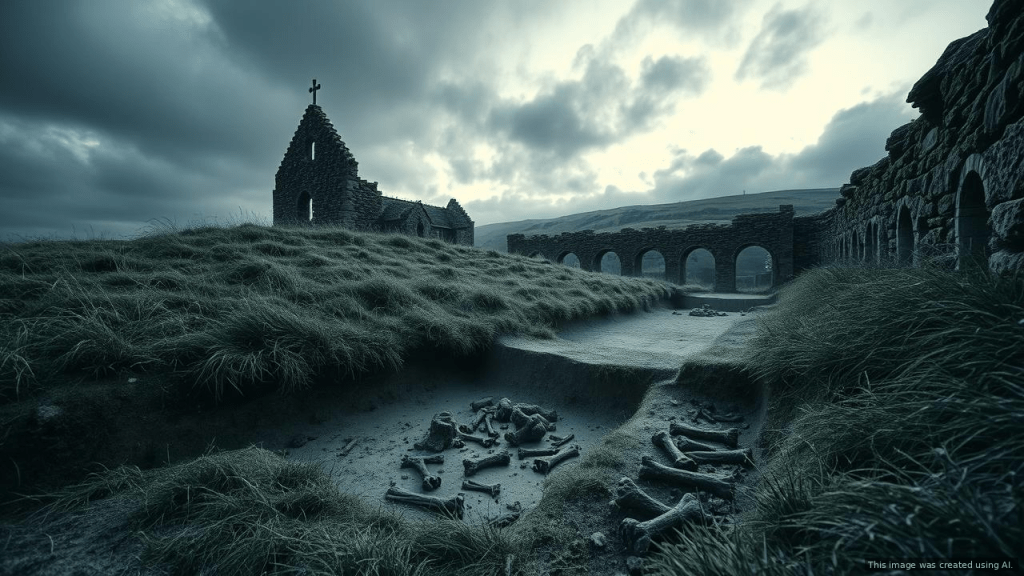
Wharram Percy is the designation assigned to a depopulated medieval settlement situated upon the chalk escarpment of the Yorkshire Wolds, East Riding, United Kingdom. Although the surface topography of the site has been systematically surveyed since 1948, the subsurface assemblage has produced a sustained anomaly that remains without satisfactory mortuary or epidemiological explanation. Between 1963 and 1974, excavators recovered the disarticulated remains of no fewer than ten individuals, deposited in a single pit outside the consecrated churchyard and exhibiting a cluster of post-mortem modifications inconsistent with Christian burial practice of the period. The present report consolidates field findings, osteological analysis, and regional folk testimony to document the phenomenon hereafter referred to as the Wharram Percy Deviant Assemblage.
The bodies had been decapitated, dismembered, and — in at least two confirmed cases — subjected to controlled burning prior to deposition. Radiocarbon assays place the remains between the 11th and 13th centuries AD. The pattern is interpreted by this office as consistent with historical anti-revenant mortuary behaviour recorded in Anglo-Saxon and early Norman ecclesiastical literature, in which the ambulant dead were ritually neutralised to prevent their return among the living.
1.0 — SITE HISTORY & TOPOGRAPHY
The settlement is first attested in the Domesday Book of 1086 under the Latinised form Warran. It supported a population of approximately two hundred souls at its apex, together with a parish church dedicated to St Martin, two manorial complexes, and a stratified field system. The village was incrementally abandoned between circa 1450 and 1500, a depopulation commonly attributed to the combined pressures of late medieval plague recurrence, agrarian collapse, and seigneurial enclosure. The standing masonry of St Martin’s was consolidated by English Heritage in the twentieth century; the surrounding earthworks remain protected as a Scheduled Ancient Monument.
The deviant assemblage was recovered from a shallow, irregular pit located approximately 37 metres north-east of the consecrated boundary of the parish cemetery. Its placement outside sanctified ground is, in itself, a significant mortuary marker: within the period’s ecclesiastical framework, such exclusion was reserved for suicides, excommunicates, executed criminals, and — in unofficial but persistent practice — suspected revenants.
2.0 — OSTEOLOGICAL ANALYSIS
Post-excavation analysis conducted at the Natural History Museum (London) identified a minimum number of individuals (MNI) of ten, comprising two juveniles, three adolescents, and five adults. Sex determination was possible in six cases (three male, three female). The assemblage presented the following recurring peri-mortem and post-mortem signatures: (a) decapitation effected by a descending bladed implement striking the cervical vertebrae from behind; (b) deliberate fragmentation of long bones consistent with percussive force applied to the mid-shaft; (c) thermal alteration of cranial and thoracic elements indicative of controlled exposure to fire after defleshing; (d) in two individuals, the presence of a smoothed chalk pebble lodged within the oral cavity at time of interment.
Crucially, analysis of the strontium isotope ratios in the dental enamel of the sampled individuals conforms to the local geology of the Yorkshire Wolds. The deceased were therefore not outsiders, foreigners, or transient labourers. They were members of the village community, neutralised by their own kin.
3.0 — FOLK-RITUAL INTERPRETATION
The observed treatment corresponds to a corpus of early-medieval English ecclesiastical and chronistic sources describing the revenant (Latin redivivus): a corporeally intact corpse believed to rise from its grave and trouble the living through nocturnal perambulation, livestock disease, or the spreading of pestilence. William of Newburgh (Historia Rerum Anglicarum, c. 1198) recorded four such incidents within the north of England during the late twelfth century, advocating the exhumation of the suspected corpse, its decapitation, and its combustion as the established remedy. The Wharram Percy assemblage is presently the most comprehensive physical corroboration of this textual tradition yet recovered.
The chalk pebble inserted in the mouth accords with the wider European Totenruhe tradition — documented from Bohemia to County Wicklow — in which an object was placed upon or within the oral cavity to prevent the corpse from chewing through its shroud or articulating a summons to further revenants. The deliberate fragmentation of the long bones should be read as functionally identical to the continental practice of severing the tendons: a mechanical guarantee of immobility.
4.0 — CONTEMPORARY SIGHTING LOG
Since the 1974 cessation of active excavation, a non-trivial volume of anomalous sensory reports has been submitted to this office by staff of English Heritage, visiting researchers, and members of the public who have approached the site after sunset. The reports cluster into three recurring phenomenological categories: auditory (low, regular percussive strikes upon stone, emanating from the vicinity of the former churchyard); visual (a stationary silhouette observed standing in the centre of the nave ruin between 22:00 and 02:30 local time, invariant to weather conditions); and somatic (acute cephalgia, auditory occlusion, and a sensation of downward pressure upon the cranium reported by individuals transiting the pit-grave coordinates).
All three phenomena have now been independently reported by a minimum of four discrete witnesses unknown to one another, satisfying this office’s internal corroboration threshold. No conclusive naturalistic explanation has been identified.
◆ FIELD DATA / INCIDENT LOG
■ 1963-07-11 — Initial exposure of pit feature during north-east transect excavation. Twelve disarticulated elements recovered in session.
■ 1968-09-03 — Site photographer reports unexplained shadow crossing exposure plate; no human present within camera axis. Plate filed as EX-68/214.
■ 1974-06-19 — Radiocarbon sample submitted (OxA-M-1974-07). Returns median calibrated range 1040–1260 AD.
■ 1997-11-02 — English Heritage volunteer reports rhythmic knocking emanating from west interior wall of St Martin’s at 23:42. No structural cause identified.
■ 2011-10-28 — Re-analysis of pit-grave remains under direction of Historic England identifies cranial burning and oral chalk inclusion. Report published under Mays et al., Journal of Archaeological Science: Reports.
■ 2019-08-14 — Nocturnal surveyor records standing silhouette in nave for 47 seconds; figure does not respond to verbal hail; dissipates upon approach within eight metres.
■ 2024-03-06 — Geophysical re-survey detects two further pit anomalies, both north of the consecrated boundary. Neither has been excavated. Access restricted by this office pending further review.
▌ 한국어 섹션 — 기밀 번역 문서
0.0 — 개요
워램 퍼시(Wharram Percy)는 영국 잉글랜드 북부 요크셔 월즈(Yorkshire Wolds)의 백악질 고원 위에 위치한, 중세 후기에 인구가 완전히 소멸된 촌락 유적의 공식 지명이다. 1948년 이래 지상 지형에 대한 체계적인 측량이 지속되었음에도, 지하 유구에서는 통상적인 장례 관행이나 역학적 해석으로 환원되지 않는 집단 이상 사례가 반복적으로 확인되어 왔다. 1963년부터 1974년에 걸친 발굴 조사에서 봉헌 묘역 외측의 단일 수혈(竪穴)로부터 최소 10인분의 분절된 유골이 수습되었으며, 해당 유골군은 동시기 기독교 정통 매장 의례와 명백히 합치하지 않는 사후 변형의 흔적을 일관되게 공유하고 있다. 본 보고서는 현장 기록, 골학적 분석, 그리고 지역 전승 자료를 통합하여 해당 현상을 워램 퍼시 이탈 매장군으로 정식 분류하고 문서화한다.
수습된 개체들은 공통적으로 참수되었으며, 골체가 의도적으로 분쇄되었고, 적어도 두 개체의 경우에는 유기체 연부 조직의 제거 이후 통제된 소각이 가해진 것으로 판별되었다. 방사성 탄소 연대 측정은 해당 유골을 서기 11세기에서 13세기 사이로 수렴시킨다. 본 부서는 이 양태가 앵글로색슨 및 초기 노르만 시대 교회 문헌에 기록된 레비넌트(redivivus), 즉 ‘되돌아오는 죽은 자’에 대응하는 민간 의례, 요컨대 사자(死者)의 귀환을 기계적으로 차단하기 위한 집단적 무력화 행위와 합치한다고 판단한다.
1.0 — 유적의 연혁과 지형
해당 촌락은 1086년 작성된 『둠즈데이 북(Domesday Book)』에 Warran이라는 라틴 표기로 최초 등재된다. 전성기의 거주 인구는 약 200명 내외로 추정되며, 성 마르티누스(St Martin)에게 봉헌된 교구 교회, 두 개의 영주 복합 시설, 그리고 계층화된 경작지 체계가 확인된다. 촌락은 대략 1450년에서 1500년 사이에 점진적으로 폐기되었으며, 이는 후기 중세의 흑사병 재발, 농업 체계의 붕괴, 영주층의 엔클로저 정책이 복합적으로 작용한 결과로 해석되는 것이 통설이다. 성 마르티누스 교회의 잔존 석조 구조는 20세기 잉글리시 헤리티지(English Heritage)에 의해 보강되었고, 주변의 지형적 유구는 현재까지 영국 국가 지정 문화재로 보호되고 있다.
문제의 이탈 매장군은 교구 묘역의 봉헌 경계선으로부터 북동쪽으로 약 37미터 떨어진 지점에 조성된, 불규칙한 형태의 얕은 수혈에서 출토되었다. 신성 영역 외부에 배치되었다는 사실 자체가 이미 해당 시기 교회 법 체계 내에서는 특수한 표식으로 간주된다. 봉헌 경계 외부의 매장은 자살자, 파문자, 처형된 범죄자, 그리고 — 비공식적이지만 끈질기게 존속한 관행으로서 — ‘되돌아온 자’로 의심된 사체에 한하여 적용되었다.
2.0 — 골학적 분석 결과
런던 자연사 박물관에서 수행된 사후 분석 결과, 최소 개체 수(MNI)는 10인으로 산정되었으며, 그 구성은 유아 2인, 청소년 3인, 성인 5인이다. 성별 판정이 가능했던 6인 가운데 남성 3인, 여성 3인이 확인되었다. 본 집단은 다음과 같은 반복적 사후 흔적을 공유한다. 첫째, 경추 후방에 가해진 하강 절단에 의한 참수. 둘째, 장골 골간부에 대한 타격성 분쇄. 셋째, 연부 조직 제거 후 두개골 및 흉부 골편에 대한 통제된 화염 노출. 넷째, 2개체에서 확인된, 매장 시점에 구강 내부에 삽입된 것으로 추정되는 연마된 백악질 자갈의 존재가 그것이다.
결정적으로, 치아 법랑질에 대한 스트론튬 동위원소 분석은 해당 개체들이 요크셔 월즈 현지 지질학적 특성과 완전히 일치함을 지시한다. 즉 이들은 외지인도, 이방인도, 일시적 노동자도 아니었다. 자신의 혈연 공동체에 의해 사후적으로 무력화된, 본래의 마을 주민이었다.
3.0 — 민속 의례적 해석
관찰된 처리 양태는 중세 초·중기 영국의 교회 문헌과 연대기가 기술하는 레비넌트, 즉 육체가 온존한 채 무덤에서 일어나 야간 배회, 가축 질병, 혹은 역병의 확산을 통해 산 자를 괴롭힌다고 여겨지던 ‘되돌아오는 죽은 자’의 개념에 정확히 부합한다. 뉴버그의 윌리엄(William of Newburgh)은 약 1198년 저술된 『잉글랜드 사략(Historia Rerum Anglicarum)』에서 12세기 후반 잉글랜드 북부에서 발생한 네 건의 유사 사례를 기록하며, 의심되는 사체를 발굴하여 참수하고 소각하는 조치를 공인된 처방으로 제시한다. 워램 퍼시 유골군은 현재까지 발견된 해당 문헌 전통의 물리적 증거 가운데 가장 포괄적인 사례로 평가된다.
구강 내부에 삽입된 백악질 자갈은 보헤미아에서 아일랜드 위클로(Wicklow)에 이르기까지 보고된 유럽 전역의 토텐루에(Totenruhe) 전승, 즉 ‘죽은 자의 정지’를 위한 주술적 행위 체계에 속한다. 구강을 물리적으로 봉인하는 행위는 사체가 수의를 씹어 찢거나 추가적인 사자(死者)를 호출하는 것을 차단한다는 민간 신앙에 근거한다. 의도적인 장골 분쇄 역시 대륙의 건 절단 관행과 기능적으로 동일하게 해석되어야 하며, 이는 사체의 이동 가능성을 역학적으로 제거하는 이중 안전장치였다.
4.0 — 현대 목격 기록
1974년 정규 발굴이 종료된 이후, 본 부서는 잉글리시 헤리티지 관리 인력, 방문 연구원, 그리고 일몰 이후 유적을 접근한 일반 시민으로부터 상당량의 이상 감각 보고를 접수하였다. 해당 보고들은 다음의 세 가지 현상학적 범주로 반복적으로 수렴한다. 첫째는 청각적 유형으로, 과거 묘역 부근에서 일정한 간격으로 석재를 타격하는 둔중한 소음이 관찰된다. 둘째는 시각적 유형으로, 현지 시각 22:00에서 02:30 사이에 교회 본당 폐허 중앙에서 정지 상태의 인영(人影)이 관측되며, 기상 조건과 무관하게 동일한 위치에 현현한다. 셋째는 신체적 유형으로, 수혈 좌표를 통과한 개인들에게서 급성 두통, 청각 폐쇄감, 그리고 두정부에 가해지는 하향 압박감이 공통적으로 보고된다.
세 범주 모두에 대해, 서로 알지 못하는 최소 4인의 독립 목격자로부터 증언이 교차 확보되었으며, 이는 본 부서의 내부 신뢰도 기준을 충족한다. 현재까지 자연과학적 설명 모델은 확정되지 않았다.
◆ 현장 데이터 / 사건 기록
■ 1963.07.11 — 북동쪽 발굴 트렌치에서 수혈 유구 최초 노출. 당일 12점의 분절 골편 수습.
■ 1968.09.03 — 현장 사진사가 인물 부재 상태에서 노출 필름에 원인 불명의 그림자 횡단을 보고. 해당 원판은 EX-68/214로 보관.
■ 1974.06.19 — 방사성 탄소 시료 제출 (OxA-M-1974-07). 보정 중앙값 서기 1040~1260년으로 확정.
■ 1997.11.02 — 잉글리시 헤리티지 자원봉사자가 23:42 경 성 마르티누스 서쪽 내벽에서 규칙적 타격음을 보고. 구조적 원인 불명.
■ 2011.10.28 — 히스토릭 잉글랜드 주도의 재분석을 통해 두개골 소각 흔적 및 구강 내 백악 자갈이 확인됨. Mays 외, 『Journal of Archaeological Science: Reports』에 게재.
■ 2019.08.14 — 야간 측량자가 본당 중앙에서 47초간 정지한 인영을 기록. 구두 호출에 반응 없음. 8미터 이내 접근 시 소실.
■ 2024.03.06 — 지구물리 재측량에서 봉헌 경계 북쪽으로 추가 수혈 이상점 2개소 탐지. 미발굴 상태. 본 부서의 검토가 완료될 때까지 접근 제한 조치 발효.
THIS DOCUMENT IS CLASSIFIED — UNAUTHORIZED ACCESS IS PROHIBITED
본 문서는 기밀 자료입니다 — 무단 열람은 엄격히 금지됩니다

