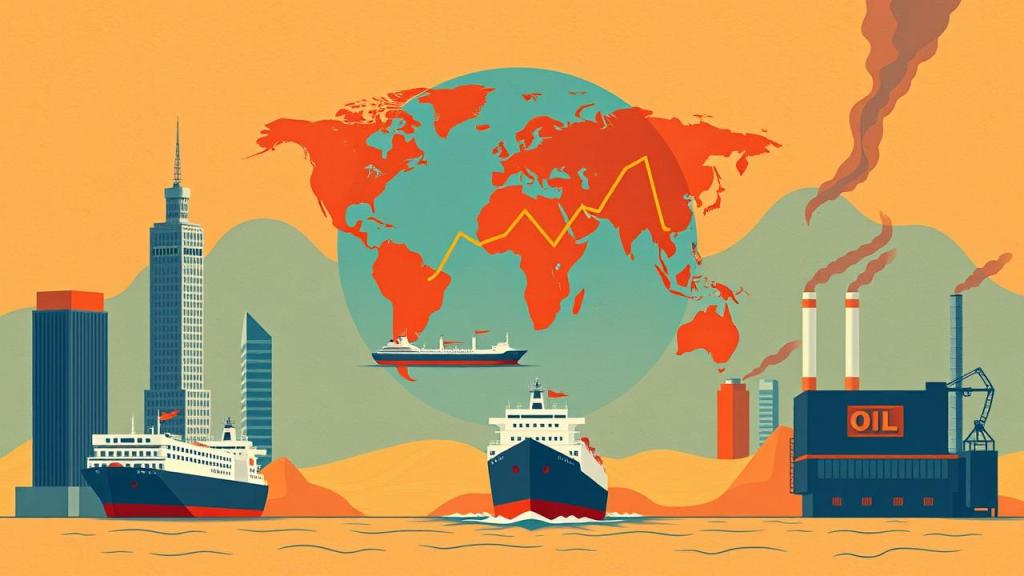
🌐 Global Economy Briefing — 2026-04-23
Markets opened Thursday gripped by a familiar cocktail: surging oil, sticky inflation, and a geopolitical risk premium that refuses to fade. The IMF’s freshly released April outlook reframed 2026 as “the global economy in the shadow of war,” and from Washington to Beijing to Mumbai, policymakers are recalibrating in real time.
🛢️ Brent Hits $96 as Strait of Hormuz Disruption Deepens
🔥 Largest Supply Disruption in History
Brent crude settled near $96.32 a barrel this week — nearly $30 higher than a year ago — as continued attacks on Middle East energy infrastructure and tanker restrictions through the Strait of Hormuz took 10.1 million barrels per day of supply offline in March, the biggest single-month hit on record.
📰 From Regional Flare-Up to Global Energy Shock
What began as a contained conflict has metastasized into a chokepoint crisis. OECD members have already agreed to release strategic reserves, and the IEA’s April Oil Market Report lays out a path in which Brent peaks near $115 in Q2 before easing only late in the year. European gas prices, meanwhile, are up roughly 98% on geopolitical stress.
📊 KEY DATA
▸ Brent spot $96.32/bbl (Apr 21) ▸ Supply drop 10.1 mb/d in March ▸ Q2 Brent forecast peak $115/bbl ▸ US retail gasoline projected ~$4.30/gal ▸ EU gas +98% YoY
🌍 Importers Absorb the Bill, Exporters Bank Windfalls
The energy shock is redistributing global income. Net oil importers across Asia and Europe face widening trade deficits and currency pressure, while Gulf producers and other exporters are seeing fiscal surpluses swell. Shipping rerouted around the Cape of Good Hope is lengthening delivery times and reigniting supply-chain cost pass-through.
👁 WHAT TO WATCH
Next IEA Oil Market Report (mid-May), OPEC+ ministerial meeting early June, and any shift in the US Strategic Petroleum Reserve release schedule. Tanker traffic metrics through Hormuz remain the daily bellwether.
🎙 EXPERT TAKE
The IEA warned in its April 2026 Oil Market Report that the March disruption is “the largest in history,” and IMF staff noted in the April WEO that a severe-scenario shock could lift one-year inflation expectations 130 bps in emerging markets excluding China.
💡 Energy Is Back as the Macro Master Variable
Every other macro call — rates, growth, FX — now routes through the price of a barrel.
🌐 IMF Cuts Global Growth as War Reshapes 2026 Outlook
🔥 “Global Economy in the Shadow of War”
The IMF’s April 2026 World Economic Outlook — titled bluntly “Global Economy in the Shadow of War” — trims world growth to 3.1% this year and 3.2% in 2027, and flags a synchronized rise in headline inflation before an expected 2027 cooldown.
📰 Resilience Meets a Harder Test
After three years in which the world economy shrugged off pandemic aftershocks and a tightening cycle, the combination of Middle East conflict, trade frictions, and thinner fiscal buffers is stress-testing that resilience. Emerging markets bear the sharpest downgrade, where the hit to growth and the jump in prices are most pronounced.
📊 KEY DATA
▸ Global GDP 3.1% (2026) / 3.2% (2027) ▸ China revised to 4.4% ▸ Euro area ~1% ▸ Germany 1.0% / France 0.6% ▸ Emerging Asia inflation 1.1% → 2.6%
🌍 The Divergence Problem Returns
The US is still expected to grow around 2.4% on a Q4/Q4 basis, leaving a widening gap with Europe and many emerging markets. That divergence tends to pull capital toward the dollar, tighten financial conditions in EM, and amplify debt-servicing stress for poorer, import-dependent countries.
👁 WHAT TO WATCH
IMF-World Bank Spring Meetings communiqués this week, the G20 finance track follow-up, and updated country Article IV reports — particularly for China, India, and frontier markets.
🎙 EXPERT TAKE
At the April 14 press briefing in Washington, IMF Chief Economist staff said downside risks now dominate — citing “a longer or broader conflict, worsening geopolitical fragmentation, a reassessment of AI-driven productivity, or renewed trade tensions” as the key fault lines.
💡 Slower, More Fragmented, More Fragile
The baseline is no recession, but the margin for policy error has thinned sharply.
🇺🇸 Fed Boxed In as Inflation Refuses to Die
🔥 Policy Rate Near Neutral, Oil in the Way
The Federal Reserve’s target range sits at 3.50%–3.75% after 175 basis points of cuts since August 2024 — but with headline inflation lifted by energy and core still above the 2% target, officials are signaling very little room for additional easing in 2026.
📰 A Soft Landing Under New Pressure
GDP is tracking a solid 2.4% Q4/Q4 pace for 2026 and unemployment is holding near 4%, but the April Beige Book described activity as “stable at subdued levels,” with firms in a wait-and-see posture on hiring and capex as the Middle East conflict clouds pricing and investment decisions.
📊 KEY DATA
▸ Fed funds 3.50–3.75% ▸ 2026 GDP forecast 2.4% (Q4/Q4) ▸ Unemployment ~4% ▸ 175 bps of cuts since Aug 2024 ▸ Powell term expires May 2026
🌍 A Strong Dollar Squeezes Everyone Else
Higher-for-longer US rates paired with the oil shock are firming the dollar, tightening global financial conditions, and raising dollar-denominated debt service costs for emerging markets already coping with costlier energy imports.
👁 WHAT TO WATCH
The FOMC’s next decision, upcoming PCE and payrolls prints, and — perhaps most consequentially — the White House’s nomination for the next Fed Chair, with Powell’s term ending in May 2026.
🎙 EXPERT TAKE
Vice Chair Philip Jefferson, in his April 7, 2026 speech, emphasized a patient stance given energy-driven upside risks, while iShares’ 2026 Fed Outlook argued the bar for further cuts has “moved meaningfully higher” after the commodity shock.
💡 Patience Is the New Policy
Investors betting on aggressive rate cuts this cycle are likely to be disappointed.
🇨🇳 Beijing Picks Stability, Europe Picks a Fight
🔥 Overcapacity Becomes a Transatlantic Flashpoint
Germany is losing roughly 10,000 manufacturing jobs every month, and Berlin and Paris are piling pressure on Brussels for tougher trade defense against Chinese overcapacity — a dispute that is quickly becoming the defining fault line of the EU-China economic relationship.
📰 China’s Supply-Side Bet
China has set a 2026 GDP target of 4.5–5.0% — below last year’s goal — and is leaning into technological self-reliance, semiconductors, green tech and EVs rather than broad demand stimulus. The IMF has trimmed China’s 2026 growth to 4.4%, citing weak consumer demand and trade frictions.
📊 KEY DATA
▸ China GDP target 4.5–5.0% ▸ IMF 2026 forecast 4.4% ▸ Germany manufacturing job losses ~10,000/month ▸ 15th Five-Year Plan R&D growth ≥7%/yr ▸ Core digital economy target 12.5% of GDP by 2030
🌍 Cheap Chinese Exports, Expensive European Politics
Chinese factory-gate prices are squeezing European manufacturers’ margins and accelerating calls for local-content rules and tariffs. Expect more EU anti-subsidy probes, and retaliatory moves from Beijing targeting European luxury, auto, and agricultural exports.
👁 WHAT TO WATCH
EU Commission trade defense decisions in Q2, China’s Politburo mid-year economic readout, and German industrial production data for April and May.
🎙 EXPERT TAKE
Coface (April 2026) argues Chinese overcapacity is “not a temporary phenomenon but a significant and likely lasting trend,” while Deutsche Bank Research described China’s 2026 blueprint as “navigating a path of stability and strategic growth.”
💡 The EU-China Decoupling Is Becoming Structural
Trade policy, not monetary policy, will set the tone for 2026’s big industrial winners and losers.
🌏 Emerging Asia: Resilience Tested by the Energy Shock
🔥 Growth Moderates, Prices Accelerate
Developing Asia’s 5.4% expansion in 2025 is set to slow to 4.4% in 2026 and 4.2% in 2027, even as inflation in emerging Asia more than doubles from 1.1% to 2.6%, driven by upward revisions in China and India.
📰 From Tariff Front-Loading to Oil Drag
Last year’s strong exports were flattered by front-loading ahead of US tariff hikes and a semiconductor boom. With that pull-forward fading and the Middle East conflict lifting energy costs, the region’s net-importer economies — India, the Philippines, Thailand — face simultaneously tighter margins and firmer inflation.
📊 KEY DATA
▸ Developing Asia growth 5.4% → 4.4% → 4.2% (2025–27) ▸ South Asia 6.8% → 6.3% in 2026 ▸ EM ex-China inflation expectations could rise 130 bps in severe scenario ▸ ADB early-stabilization scenario: 5.1%
🌍 Capital Flight Risk Looms Again
A stronger dollar plus higher oil is a familiar, painful combination for emerging markets. Current account deficits widen, local currencies weaken, and central banks that had begun easing — including in India and Indonesia — may be forced to pause or even reverse.
👁 WHAT TO WATCH
Upcoming rate decisions from the Reserve Bank of India and Bank Indonesia, China’s Q2 activity data, and ADB’s updated Asian Development Outlook supplement later in the quarter.
🎙 EXPERT TAKE
The IMF blog of April 16, 2026 was blunt: “Asia’s economic resilience is being tested by the energy shock,” with staff noting that higher oil prices hit Asia harder than most regions because of its heavy reliance on imported crude.
💡 The 2020s Growth Engine Just Got Noisier
Asia still leads global growth — but the ride in 2026 will be bumpier than investors had penciled in.
※ This content is automatically generated from public news sources. For reference only — not investment advice.

