| DOCUMENT TYPE: CRYPTOZOOLOGICAL FIELD REPORT | DOC-ID: ARC-2026-7834 |
| CLASSIFICATION: TOP SECRET // NOFORN | ARCHIVE DATE: 2026.04.17 |
| LEAD RESEARCHER: Dr. S. Whitfield, Dept. of Anomalous Zoology | INCIDENT SITE: Lindi Region, Tanzania — 10.0°S, 39.7°E |
▌ ENGLISH SECTION — PRIMARY DOCUMENTATION
SUBJECT OVERVIEW & NOMENCLATURE
The Mngwa (Swahili: mgwa, lit. “The Strange One”), alternatively transcribed as Nunda in older British colonial field notes, designates an unclassified large felid purportedly inhabiting the coastal jungle belt of southeastern Tanzania, with primary sighting concentrations documented within the Lindi and Mtwara administrative districts. The subject resists assignment to any recognized species within the family Felidae. Colonial-period wildlife officers of the British East Africa Protectorate formally logged the entity between 1900 and 1938, with the most intensive documentation clustering around the Lindi municipal area during 1922–1923, following a series of fatal attacks attributed to the creature. The Mngwa occupies a distinct taxonomic ambiguity: morphological descriptions provided by surviving witnesses, indigenous informants, and post-attack physical evidence suggest a felid of extraordinary size, possessing coat patterning inconsistent with any known subspecies of leopard (Panthera pardus), lion (Panthera leo), or cheetah (Acinonyx jubatus).
PHYSICAL DESCRIPTION & DISTINGUISHING CHARACTERISTICS
Convergent witness testimony and physical trace evidence permit a provisional composite profile. The subject is consistently described as substantially larger than a fully mature male lion, with estimated shoulder height in the range of 1.0–1.3 metres and a body length exceeding 2.5 metres exclusive of tail. The coat is reported as grey or grey-brown in base tone, overlaid with a diffuse, brindled or dappled pattern that does not conform to the rosette structure of leopard pelage, the solid tawny field of the lion, or the high-contrast spot pattern of the cheetah. This coloration is described by indigenous informants as resembling the bark of an aged mangrove, enabling near-total concealment within the coastal thicket environment. The skull, as inferred from bite-force evidence on recovered human and livestock remains, suggests a cranial architecture of considerable robustness, producing puncture wounds of a diameter and inter-canine spacing significantly exceeding that of any locally documented felid. Track casts obtained by District Officer R. Haskett in November 1922 from a site 4.2 kilometres north-northwest of Lindi township measured 18.4 cm in length and 16.1 cm in width — dimensions that exceed recorded maximums for the Bengal tiger (Panthera tigris tigris) and substantially surpass all East African Felidae.
HABITAT & BEHAVIOURAL PROFILE
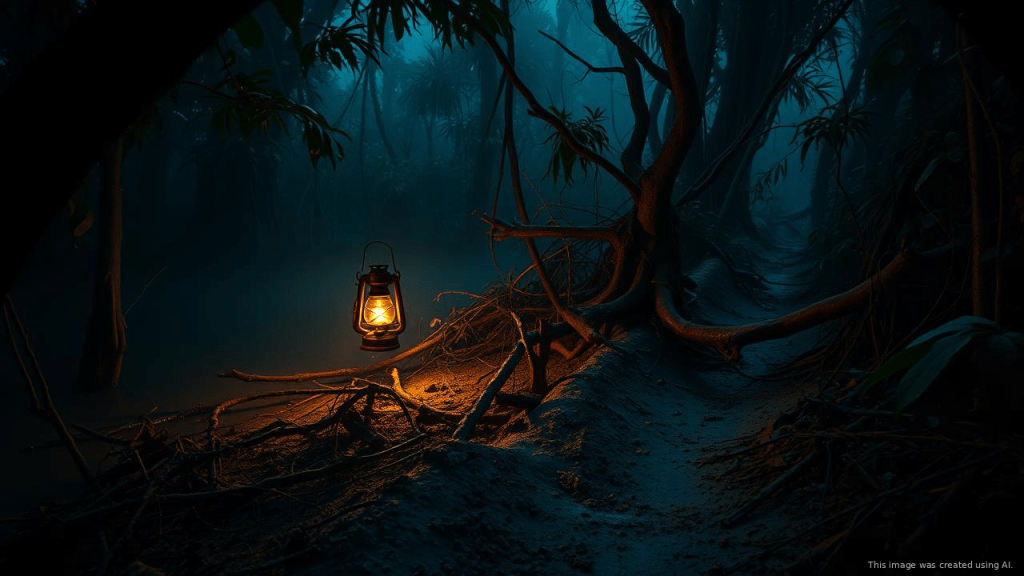
The operational habitat of the Mngwa, as reconstructed from the geographic distribution of attributed incidents, encompasses the coastal forest mosaic of southeastern Tanzania — a zone characterised by dense Brachystegia and Cynometra woodland, extensive mangrove estuary networks, and significant nocturnal humidity. Unlike the open-savanna hunting strategies employed by lions, the Mngwa is uniformly described as an ambush predator of the closed-canopy environment, operating exclusively between dusk and pre-dawn. Indigenous Makonde, Yao, and Zaramo informants consulted during the 1922 investigation consistently classified the creature as wholly distinct from known predators, maintaining that its vocalisation — described as a low, arrhythmic rumbling distinct from the cough-roar of a leopard — preceded attacks by a period of approximately forty to ninety seconds, functioning as a form of territorial signal rather than a pursuit vocalisation. Tracking parties reported that the Mngwa did not flee upon detecting human presence but instead appeared to conduct deliberate, sustained surveillance of search groups from concealed positions, suggesting a predatory intelligence and threat-assessment capability not typically associated with known African felids. Agricultural livestock, primarily goats and cattle penned within village perimeters, constituted a documented supplementary prey source, with enclosures breached by methodologies — including the displacement of heavy wooden reinforcing poles — indicative of exceptional strength.
THE LINDI INCIDENT SERIES (1922–1923)
The most comprehensively documented cluster of Mngwa-attributed events occurred within a fourteen-month period centred on the Lindi township, representing the only sustained episode for which contemporaneous administrative records survive in the Tanzanian National Archives (Collection TNA/G3/7, Sub-file 1922-LND). A series of nine fatalities and four serious maulings were formally attributed to an unidentified large predator operating within a corridor approximately 11 kilometres in length along the coastal scrubland north of Lindi. The colonial administration dispatched experienced game hunters, including Mr. W. Hichens and Mr. Patrick Bowen — the latter a professional hunter of established credentials — to investigate and neutralise the subject. Both Hichens and Bowen filed reports acknowledging that the physical evidence was inconsistent with any known large predator of the region. Hichens, whose account was later excerpted in the journal Discovery (Vol. 8, 1937), noted that the track casts recovered bore no resemblance to lion, leopard, or any catalogued species, and that the uniformity of witness descriptions across interviews conducted independently — including the distinctive grey-brindled coat — precluded simple misidentification of a known animal. No confirmed specimen was obtained. All organised pursuit attempts concluded without direct engagement. Attacks ceased abruptly in late 1923 without documented explanation.
SUBSEQUENT SIGHTINGS & CURRENT RESEARCH STATUS
Following the cessation of the 1922–1923 Lindi incident series, documented Mngwa-attributed reports became sparse but did not terminate entirely. Scattered accounts from the Rufiji River delta region (1941, 1958), the Ruvuma Forest Reserve (1974), and the Selous Game Reserve periphery (1989, 2004) describe large unidentified felids with coat patterns inconsistent with known species. A 2011 field investigation conducted under the auspices of the Centre for Anomalous Zoological Studies (CAZS, Nairobi, Ref. CAZS-KE-2011-04) recovered hair samples from a trail camera site in coastal Lindi Region. Mitochondrial DNA analysis performed at the University of Nairobi’s Department of Biological Sciences yielded an incomplete sequence showing 94.7% homology with Panthera pardus while exhibiting three anomalous base-pair substitutions in the cytochrome b gene region not previously documented in any deposited felid sequence. The researchers classified the result as “analytically inconclusive pending whole-genome sequencing of a complete tissue sample.” No such sample has been obtained as of the current archive date. The Mngwa remains unclassified within the IUCN species database and is designated SUBJECT OPEN — UNRESOLVED in the CAZS anomalous fauna registry.
◆ FIELD DATA / INCIDENT LOG — LINDI DISTRICT 1922–1923
INC-001 | 1922.03.11 | LINDI N. PERIMETER | FATALITY — Adult male, fisherman. Dorsal cranial compression consistent with large felid bite. No large predator tracks matching known species. Status: UNSOLVED
INC-002 | 1922.04.29 | MSIMBATI FOREST EDGE | FATALITY — Adult female. Claw laceration pattern, estimated paw width 16+ cm. Livestock enclosure breach adjacent. Status: UNSOLVED
INC-003 | 1922.08.07 | 4.2 km NNW LINDI TOWN | TRACK CAST OBTAINED by D.O. R. Haskett. Measurements: 18.4 cm L × 16.1 cm W. Stride pattern: 1.92 m. Cast deposited: Lindi District Office Archive. Status: PHYSICAL EVIDENCE ON FILE
INC-004 | 1922.11.14 | LINDI NORTH | MAULING — Adult male (survived, partial right arm loss). Witness report: “Grey animal, size of a donkey but low and cat-like. Coat like old wood. No lion, no cheetah.” Status: WITNESS TESTIMONY ARCHIVED
INC-005 | 1923.01.03 | RONDO PLATEAU APPROACH | HUNTER PATROL REPORT (W. Hichens): Three-hour surveillance. Subject detected human presence and withdrew into closed canopy. No visual confirmation. Status: INCONCLUSIVE
INC-006–009 | 1922–1923 | VARIOUS LINDI SITES | FURTHER FATALITIES × 5, MAULINGS × 3. Pattern consistent. No specimen recovered. Attacks ceased: late 1923.
▌ 한국어 섹션 — 기밀 번역 문서
개요 및 명칭 기원
음과(Mngwa, 스와힐리어: mgwa, 직역 “이상한 것”)는 동아프리카 탄자니아 남동부 해안 밀림 지대에 서식하는 것으로 보고된 미분류 대형 고양잇과 생물체에 대한 공식 명칭이다. 과거 영국 식민지 행정 문서에서는 동일 개체 또는 동일 종으로 추정되는 생물을 ‘눈다(Nunda)’로도 표기하였다. 주요 목격 사례는 린디(Lindi) 및 므트와라(Mtwara) 행정구에 집중되어 있으며, 현재까지 알려진 어떠한 고양잇과(Felidae) 종으로도 분류되지 않는다. 영국 동아프리카 보호령 식민지 야생동물 관리관들은 1900년에서 1938년 사이에 해당 생물과 관련된 사건을 공식 기록으로 남겼으며, 가장 집중적인 사건 군집은 1922년에서 1923년 사이 린디 지구에서 발생한 일련의 치명적 습격 사건들이다. 생존 목격자, 현지 정보 제공자, 그리고 사후 물리적 증거들이 묘사하는 형태학적 특성은 표범(Panthera pardus), 사자(Panthera leo), 치타(Acinonyx jubatus) 가운데 그 어떤 아종과도 일치하지 않는다.
신체적 특징 및 식별 기준
다수의 목격자 증언 및 물리적 추적 증거를 종합한 결과, 잠정적인 외형 프로파일의 구성이 가능하다. 해당 개체는 성체 수컷 사자보다 현저히 큰 체구로 묘사되며, 추정 어깨 높이는 1.0~1.3미터, 꼬리 제외 몸길이는 2.5미터를 초과하는 것으로 평가된다. 피모(被毛)는 회색 또는 회갈색 기조에 맹그로브 나무껍질을 연상시키는 불규칙한 얼룩무늬가 중첩된 형태로 보고되며, 이는 표범의 로제트 문양, 사자의 단색 황갈색, 치타의 고대비 점박이 패턴 중 어느 것과도 일치하지 않는다. 현지 마콘데(Makonde), 야오(Yao), 자라모(Zaramo) 부족 정보원들은 이 피모가 해안 밀림 환경에서 거의 완벽한 위장 효과를 제공한다고 일관되게 진술하였다. 1922년 11월, 린디 지역 행정관 R. 하스켓(D.O. R. Haskett)이 린디 시내 북서북쪽 4.2킬로미터 지점에서 채취한 발자국 석고 캐스트는 길이 18.4센티미터, 폭 16.1센티미터로 측정되었다. 이는 벵골 호랑이(Panthera tigris tigris)의 기록된 최대 발자국 수치를 초과하며, 동아프리카의 모든 알려진 고양잇과 동물을 상당한 차이로 능가하는 수치이다.
서식 환경 및 행동 양식
음과의 서식 환경은 탄자니아 남동부 해안 삼림 모자이크 — 브라키스테기아(Brachystegia) 및 시노메트라(Cynometra) 수종으로 구성된 밀림, 넓게 발달된 맹그로브 하구 네트워크, 그리고 높은 야간 습도를 특징으로 하는 지역 — 으로 재구성된다. 사자의 개활지 사냥 전략과 달리, 음과는 일관되게 폐쇄 임관(林冠) 환경 내 잠복 포식자로 묘사되며 황혼 이후 새벽 이전까지 활동한다. 해안 밀림 지대 현지 부족 정보원들은 해당 개체의 발성이 — 표범의 기침형 포효와 구별되는, 낮고 불규칙한 저음의 울림으로 묘사됨 — 습격에 40~90초 선행한다고 일관되게 보고하였다. 이 발성은 추적 발성이 아닌 영역 표시의 성격을 지닌 것으로 분석된다. 추적 대원들은 음과가 인간의 접근을 감지하였음에도 도주하지 않고, 오히려 수색 집단을 은폐된 위치에서 지속적으로 감시하는 행동을 보였다고 보고하였다. 이는 통상적인 아프리카 고양잇과 동물에서 관찰되지 않는 수준의 포식 지능을 시사한다. 마을 경계 내 가축 — 특히 염소 및 소 — 또한 보조 먹이 자원으로 기록되어 있으며, 무거운 목재 강화 기둥이 제거된 형태의 축사 침입은 해당 개체의 탁월한 완력을 시사한다.
린디 사건 연속 (1922–1923)
가장 광범위하게 문서화된 음과 관련 사건 군집은 린디 시내를 중심으로 14개월에 걸쳐 발생하였으며, 이는 탄자니아 국립문서보관소(TNA/G3/7, 서브파일 1922-LND)에 행정 기록이 현존하는 유일한 사례 연속이다. 해안 관목 지대 북쪽 약 11킬로미터 회랑을 따라 활동한 미확인 대형 포식자에 의한 사망 9건, 중상 4건이 공식 기록되었다. 식민지 행정부는 숙련된 사냥꾼인 W. 히첸스(W. Hichens)와 패트릭 보웬(Patrick Bowen)을 파견하였으나, 두 사람 모두 물리적 증거가 해당 지역의 어떠한 알려진 포식자와도 일치하지 않음을 보고서에 명시하였다. 히첸스의 기술은 후에 학술지 Discovery(제8권, 1937년)에 게재되었으며, 수집된 발자국 캐스트가 사자, 표범, 또는 알려진 여타 종의 것과 전혀 다르고, 독립적으로 수집된 목격자 진술 간의 일관성 — 특히 회색 얼룩 피모에 관한 묘사 — 은 단순한 오인 가능성을 배제한다고 결론지었다. 확인된 표본은 획득되지 않았으며, 모든 조직적 추적 시도는 직접적 교전 없이 종료되었다. 습격은 1923년 말 설명 없이 갑작스럽게 중단되었다.
이후 목격 사례 및 현재 연구 현황
1922~1923년 린디 사건 연속 종료 이후, 음과 관련 보고는 드물어졌으나 완전히 소멸되지는 않았다. 루피지(Rufiji) 강 삼각주 지역(1941년, 1958년), 루부마(Ruvuma) 삼림보호구(1974년), 셀로우스(Selous) 게임 리저브 주변부(1989년, 2004년)에서 알려진 종과 일치하지 않는 피모를 지닌 미확인 대형 고양잇과 동물 목격 보고가 산발적으로 접수되었다. 나이로비 소재 이상동물학연구센터(CAZS, 참조번호 CAZS-KE-2011-04)가 2011년 실시한 현장 조사에서는 린디 지역 해안대 트레일 카메라 설치 지점에서 모발 시료를 채취하였다. 나이로비 대학교 생물학과에서 수행한 미토콘드리아 DNA 분석 결과, 표범(Panthera pardus)과 94.7%의 상동성을 보이면서도 기존 고양잇과 등록 서열에서 전례 없는 사이토크롬 b 유전자 영역 내 3개의 이상 염기쌍 치환이 확인되었다. 연구진은 해당 결과를 “완전한 조직 시료의 전체 게놈 염기서열 분석이 완료될 때까지 분석적으로 결론 불가”로 분류하였다. 현재 아카이브 기준일 현재, 완전한 조직 시료는 확보되지 않은 상태이다. 음과는 IUCN 종 데이터베이스 내 미분류 상태를 유지하며, CAZS 이상동물 등록부에서 “조사 대상 개방 — 미해결(SUBJECT OPEN — UNRESOLVED)”로 지정되어 있다.
◆ 현장 데이터 / 사건 기록 — 린디 지구 1922–1923
사건-001 | 1922.03.11 | 린디 북방 외곽 | 사망 — 성인 남성, 어부. 두개골 후방 압착 손상, 대형 고양잇과 교상 패턴. 알려진 종과 불일치. 상태: 미해결
사건-002 | 1922.04.29 | 음심바티 삼림 경계 | 사망 — 성인 여성. 발톱 열상, 추정 발폭 16cm 이상. 인접 축사 침입 확인. 상태: 미해결
사건-003 | 1922.08.07 | 린디 시내 북서북 4.2km | 지구 행정관 R. 하스켓, 발자국 석고 캐스트 채취. 길이 18.4cm × 폭 16.1cm. 보행 간격 1.92m. 린디 지구 청사 기록 보관소 보관. 상태: 물리적 증거 파일 존재
사건-004 | 1922.11.14 | 린디 북부 | 중상 — 성인 남성 생존, 우측 팔 부분 절단. 목격자 진술: “나귀 크기의 회색 동물, 낮고 고양이 같은 형태. 피모는 오래된 나무 같았음. 사자도 치타도 아님.” 상태: 목격자 증언 보관
사건-005 | 1923.01.03 | 론도 고원 접근로 | 사냥꾼 W. 히첸스 순찰 보고서: 3시간 감시 진행, 피사체가 인간 존재 감지 후 임관 내 후퇴. 육안 확인 실패. 상태: 결론 불가
사건-006~009 | 1922–1923 | 린디 지구 여러 지점 | 추가 사망 5건, 중상 3건. 패턴 동일. 표본 미확보. 습격 중단: 1923년 말.
THIS DOCUMENT IS CLASSIFIED — UNAUTHORIZED ACCESS IS PROHIBITED
본 문서는 기밀 자료입니다 — 무단 열람은 엄격히 금지됩니다
 U_Haru