| DOCUMENT TYPE: FIELD ETHNOGRAPHIC CASE FILE | DOC-ID: ARC-2026-3847 |
| CLASSIFICATION: TOP SECRET // NOFORN | ARCHIVE DATE: 2026.04.16 |
| LEAD RESEARCHER: Dr. E. Kowalczyk, Institute of Slavic Folklore Studies, Warsaw | INCIDENT SITE: Bielany Forest District, Warsaw — 52.3147°N, 20.9226°E |
▌ ENGLISH SECTION — PRIMARY DOCUMENTATION
I. HISTORICAL ORIGIN AND CONTEXTUAL BACKGROUND
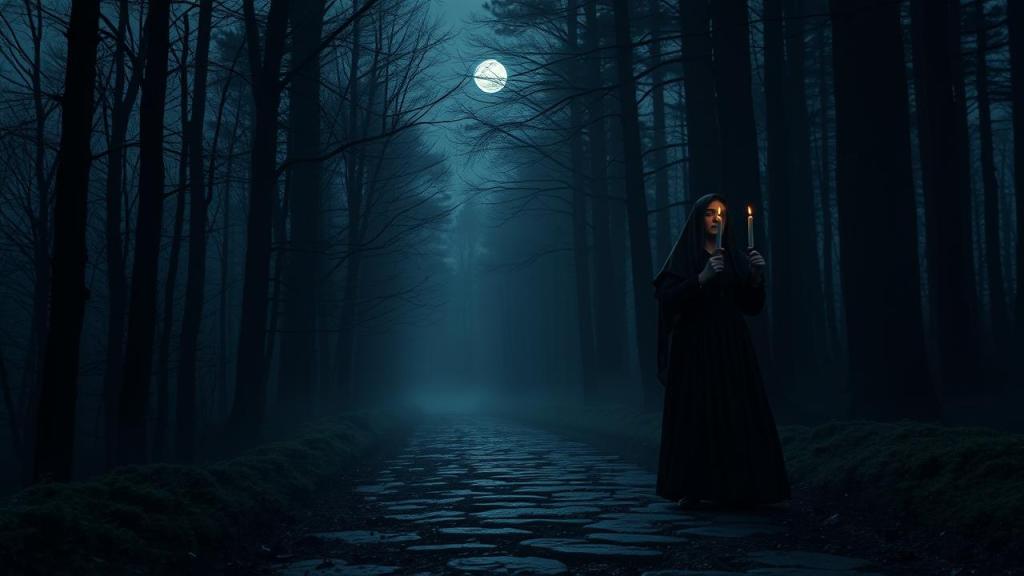
The entity designated the Świecznica Bielańska — rendered in contemporary folkloric literature as “the Candle Widow of Bielany” — is a spectral phenomenon documented within a confined geographic corridor of the Bielany Forest (Las Bielański) in the northern administrative district of Warsaw, Republic of Poland. The earliest recoverable written reference to the entity appears in an ecclesiastical notation dated 1714 CE, preserved in the archive of the Camaldolese Monastery of the Immaculate Conception (Klasztor Kamedułów na Bielanach), wherein the prior, Father Benedykt Ossoliński, recorded the repeated observations of an unnamed female figure seen traversing the monastic woodland boundary at irregular nocturnal hours. Father Ossoliński noted the figure carried what appeared to be multiple unlit black tapers and was dressed in the attire of a noblewoman of recent widowhood. His notation reads, in partial translation: “…she does not respond to lantern or call, and the novices who followed her report that her path through the snow left no impression.”
Historical context strongly implicates the Great Northern War (1700–1721) as the generative event from which the legend crystallized. Warsaw and its environs suffered repeated military incursions, most notably the siege and sack of 1702–1705 under Swedish forces loyal to Charles XII. Oral tradition, reconstructed via ethnographic interviews conducted between 1963–1967 by researchers at the Polish Institute of Cultural History (Instytut Historii Kultury, ref. project IHK-63-F), holds that the Świecznica is the manifestation of a noblewoman — identified in some variants as Wanda Elżbieta Rutkowska-Prószyńska (c. 1681–1709) — whose husband, a cavalry officer in the service of Augustus II, was executed by Swedish forces on the monastery grounds. According to the reconstructed tradition, Pani Rutkowska-Prószyńska reportedly entered the monastery forest in the first hours following the execution, carrying votive candles she had intended to light in the chapel, and was never seen alive again. Her body was reportedly never recovered. The monks were said to have sealed a section of the crypt following the incident, the reason for which was never formally recorded.
II. PHYSICAL DESCRIPTION AND BEHAVIORAL CHARACTERISTICS
Eyewitness testimony collected across three distinct temporal clusters — pre-war accounts (1714–1939), communist-era accounts (1957–1981), and post-transition accounts (1991–present) — demonstrates a high degree of morphological consistency. The entity is invariably described as female, tall (estimated 170–180 cm), and dressed in dark or black clothing consistent with Central European mourning dress of the early 18th century. The garments are frequently described as heavy and layered, with long sleeves and a veil or head covering. The figure’s face is consistently reported as either partially obscured, turned away, or perceived as too pale and featureless to describe with precision. No witness account records the entity’s face in direct frontal exposure under conditions permitting confident identification.
The entity is invariably observed in proximity to one or more candles. In the majority of accounts, the candles are unlit and held at the figure’s side or bundled against its chest. In a statistically significant minority of accounts — particularly those recorded after 1970 — one candle is described as lit, burning with a flame characterised as unusually still and lacking the normal flicker behaviour expected in an outdoor environment. Witnesses consistently report no sound associated with the entity’s passage: no footfall, no sound of fabric movement, no breathing. Several witnesses noted the cessation of ambient forest noise — birdsong, wind, insect activity — in the seconds immediately preceding the entity’s appearance. The entity does not interact with observers and does not alter its trajectory in response to external stimuli including direct speech, physical approach, or illumination. At a distance of approximately 8–12 metres, the entity is reported to simply cease to be visible — not in a sudden disappearance, but in a gradual diminishing described by multiple witnesses as analogous to a figure walking into an increasingly dense fog, regardless of actual atmospheric conditions.
III. DOCUMENTED ENCOUNTER CHRONOLOGY
The communist-era documentation cluster is the most extensively recorded and analytically useful for systematic study. Following the construction of large-scale residential housing blocks (osiedla) in the Bielany district between 1955–1965, the civilian population proximate to the forest boundary increased substantially, producing a higher incidence of reported encounters. The records of the Municipal Social Services Bureau (Miejski Urząd do Spraw Socjalnych, Warsaw), declassified in 1993, contain seventeen formal complaint and inquiry forms submitted between 1959 and 1979 by residents of ul. Conrada and ul. Dewajtis referencing an unidentified woman seen in the forest treeline at night. The bureau, operating under ideological constraints that precluded formal acknowledgment of folkloric phenomena, categorised the reports uniformly as “incidents involving unidentified civilian activity in restricted green zones” and referred none to further investigation.
Two accounts from this cluster warrant specific notation. The first, submitted on 14 November 1963 by a resident identified in the record only as “K.B., male, 58,” describes an encounter at approximately 02:30 hours in which the witness, returning from a night shift, observed the entity from a distance of approximately 20 metres. He noted that the figure stood entirely motionless at the forest’s edge for the full duration of his observation, estimated at three to five minutes, during which period the monastery’s bell tower struck an irregular sequence — four strikes, a pause, then a single strike — which the witness found anomalous as the hour did not correspond to a canonical bell interval. The second notable account, dated 7 March 1971, was submitted by a young woman identified as “M.S.-W., female, 24,” a student at the Academy of Physical Education on ul. Marymoncka. She reported a close-proximity encounter during an early-morning run along the forest path, placing the entity at a distance she estimated at four to six metres. She reported that the entity’s candles — described as three unlit black tapers bound together — appeared to undergo spontaneous combustion at the moment of her passing, igniting simultaneously with no visible external flame source. She fled immediately and required sedation upon return to her dormitory.
IV. ETHNOGRAPHIC ANALYSIS AND CULTURAL SIGNIFICANCE
Dr. Kowalczyk’s 2019 monograph, “Widma Przywiązane do Miejsca: Studia przypadków z Mazowsza” (Place-Bound Apparitions: Case Studies from Mazovia, Wydawnictwo Akademickie, Warsaw), situates the Świecznica Bielańska within a broader typological classification of what she terms “grief-anchored residual entities” — a category of folkloric apparition whose phenomenological profile consistently aligns with traumatic death scenarios involving unresolved ritual incompletion. The candle motif is identified as particularly significant: in both Roman Catholic and older pre-Christian Polish funerary tradition, the unlit candle carried by the deceased or by a mourner at the threshold of death represents a soul that has not undergone the completion of passage rites. The figure’s persistent carrying of unlit tapers — or in later accounts, spontaneously lit ones — is interpreted as a psychic residue of the original act: the votive offering that was never delivered, the mourning rite that was never completed.
Local residents of Bielany continue to report encounters with frequency sufficient to sustain active oral transmission. A structured survey conducted by graduate researchers at the University of Warsaw’s Ethnology Department (project UW-ETH-2014-112) found that 34 of 200 adult respondents living within 800 metres of the forest boundary reported either personal sightings or second-hand accounts from immediate family members. The Camaldolese monks, who maintain a strict rule of enclosure and grant no public comment, are documented in a 2003 letter from the monastery’s bursar to the Warsaw Historic Conservation Office as having “long been aware of the tradition concerning the lady of the forest path” and as maintaining certain private devotional practices “to which the tradition is not unrelated.” No further clarification has been provided by the monastic community.
◆ FIELD DATA / INCIDENT LOG — SELECTED ENCOUNTER REGISTER
[1714.09.03] — First written record. Prior F. Ossoliński, Camaldolese Monastery. Entity observed 3 nights consecutively near eastern boundary wall. No footprints in snow.
[1939.10.11] — Wartime account. German officer’s diary entry (captured document, Warsaw Rising Archive ref. AW-1944-089K) notes “eine Frau in Schwarz” in the forest during billet rotation. Entity did not respond to challenge.
[1963.11.14] — Resident K.B. sighting. Entity stationary at treeline. Anomalous bell sequence: 4+1 strikes at 02:30 hrs. Duration approx. 4 minutes. No ambient sound throughout.
[1971.03.07] — Student M.S.-W. close encounter. Entity within 4–6 m. Spontaneous ignition of three bound black candles. Witness required medical attention.
[1989.12.28] — Post-martial law period. Two forestry workers filed report (Warsaw Municipal Forestry Service, doc. ref. LBW-89-221) describing entity standing within the tree line for approximately 45 minutes before vanishing. Both workers independently described a “smell of cold wax and iron” that lingered.
[2007.04.02] — Amateur video recording submitted to Warsaw paranormal research group (Towarzystwo Badań Paranormalnych Warszawa). Recording shows indistinct luminous vertical form near path junction at 03:10 hrs. Authenticated as unaltered by digital forensics contractor; origin remains unresolved.
[2022.01.19] — Most recent formally documented account. PhD candidate in archaeology, University of Warsaw, encountered entity while conducting pre-dawn survey of frost heave damage to historical path markers. Described entity as “absolutely still, with what I can only describe as a posture of waiting.”
▌ 한국어 섹션 — 기밀 번역 문서
I. 역사적 기원 및 배경
‘슈비에치니차 비에와인스카(Świecznica Bielańska)’로 지정된 해당 현상체 — 현대 민속학 문헌에서는 ‘비에와니의 촛불 과부’라는 명칭으로 통용됨 — 는 폴란드 바르샤바 북부 행정구역 비에와니 산림(Las Bielański) 내 좁은 지리적 범위에서 지속적으로 기록된 유령 현상이다. 이 현상체에 관한 현존하는 가장 오래된 문서 기록은 1714년 교회 문서에서 발견되며, 바르샤바 비에와니 소재 무원죄 잉태 카말돌리 수도원(Klasztor Kamedułów na Bielanach)의 기록물 보관소에 보존되어 있다. 당시 원장인 베네딕트 오쏠린스키(Benedykt Ossoliński) 수사는 신원 미상의 여성 인물이 불규칙한 심야 시간대에 수도원 삼림 경계부를 반복적으로 횡단하는 장면을 목격했다고 기술하였다. 그는 해당 인물이 수 개의 꺼진 검은 초를 소지하고 있었으며, 18세기 초 귀족 과부의 복식을 착용한 것으로 보인다고 기록했다. 그의 기록 일부를 번역하면 다음과 같다: “…그녀는 등불이나 호출에 반응하지 않았으며, 뒤를 따라간 수련 수사들은 눈 위에 그녀의 발자국이 전혀 없었다고 보고했다.”
역사적 맥락을 고려할 때, 이 전설의 형성 계기로는 대북방전쟁(1700–1721)이 강력히 지목된다. 바르샤바와 그 인근 지역은 당시 샤를 12세 지지 스웨덴군에 의해 1702–1705년에 걸쳐 반복적인 군사적 침략을 받았다. 폴란드 문화사연구소(Instytut Historii Kultury, 프로젝트 번호 IHK-63-F)의 1963–1967년 현지 민족지 조사를 통해 재구성된 구전 전승에 따르면, 슈비에치니차는 완다 엘주비에타 루트코프스카-프루신스카(Wanda Elżbieta Rutkowska-Prószyńska, c. 1681–1709)로 추정되는 귀족 여성의 현현이라 전해진다. 그녀의 남편은 아우구스투스 2세 휘하 기병대 장교로, 스웨덴군에 의해 수도원 경내에서 처형되었다. 전승에 따르면 루트코프스카-프루신스카는 처형 직후 첫 몇 시간 사이, 예배당에 봉헌하려던 봉헌 초를 들고 수도원 숲속으로 들어갔다가 생환하지 못했으며, 그녀의 시신은 끝내 발견되지 않았다고 한다. 수사들은 이 사건 이후 납골당의 일부 구역을 밀봉했으나, 그 공식적인 이유는 기록에 남겨지지 않았다.
II. 외형적 특성 및 행동 양식
전쟁 이전(1714–1939), 공산주의 시대(1957–1981), 체제 전환 이후(1991–현재)라는 세 개의 시기군으로 수집된 목격자 증언은 외형적 특성에 있어 높은 수준의 일관성을 보인다. 현상체는 예외 없이 여성으로 기술되며, 키가 크고(추정 170–180cm), 18세기 초 중부 유럽 애도 복식과 일치하는 어둡거나 검은 의복을 착용한 것으로 묘사된다. 의복은 길고 소매가 긴 층이 많은 구조로 보고되며, 머리에는 베일 또는 두건이 씌워져 있다. 현상체의 얼굴은 일관되게 부분적으로 가려져 있거나, 돌아서 있거나, 정확한 묘사가 불가능할 만큼 창백하고 특징 없는 것으로 인식된다. 어떠한 목격 기록에도 현상체의 정면 얼굴이 명확하게 확인된 사례는 존재하지 않는다.
현상체는 예외 없이 하나 이상의 초와 함께 목격된다. 대다수 증언에서 초는 꺼진 상태로 옆에 들거나 가슴에 안고 있는 것으로 묘사된다. 통계적으로 유의미한 소수의 증언 — 특히 1970년 이후 기록된 것들 — 에서는 초 하나가 점화되어 있으며, 그 불꽃은 실외 환경에서 기대되는 정상적인 흔들림 없이 비정상적으로 고요하게 타오른다고 기술된다. 목격자들은 현상체의 이동과 관련된 어떠한 음향도 보고하지 않는다: 발소리, 옷감 움직임, 호흡 소리 모두 완전히 부재한다. 다수의 목격자는 현상체가 나타나기 직전 수 초 동안 주변 숲의 소리 — 새소리, 바람 소리, 곤충 소리 — 가 완전히 차단되는 현상을 경험했다고 보고했다. 현상체는 관찰자에게 반응하지 않으며, 언어적 접근, 신체적 접근, 조명 등 어떠한 외부 자극에도 이동 경로를 변경하지 않는다. 약 8–12미터 거리에 도달하면 현상체는 갑작스럽게 사라지는 것이 아니라, 점점 짙어지는 안개 속으로 걸어들어가는 것처럼 서서히 가시성을 잃는다고 다수의 목격자가 묘사했다.
III. 목격 사례 연대기
공산주의 시대의 기록군은 체계적 연구를 위해 가장 광범위하게 문서화되어 있으며 분석 가치가 높다. 1955–1965년 사이 비에와니 지구에 대규모 공동주택(오시에들레) 단지가 건설되어 숲 경계부 인근 민간인 거주 인구가 급증하면서 목격 보고의 빈도 또한 크게 증가했다. 1993년에 기밀 해제된 바르샤바 시립 사회서비스국(Miejski Urząd do Spraw Socjalnych) 문서에는 1959년부터 1979년까지 콘라다 가(ul. Conrada)와 데바이티스 가(ul. Dewajtis) 주민들이 제출한 열일곱 건의 공식 민원 및 문의서가 포함되어 있으며, 모두 야간에 숲 경계부에서 목격된 신원 미상 여성에 관한 내용이다. 민속 현상의 공식적 인정을 금지하는 이데올로기적 제약 아래 운영된 해당 기관은 모든 보고를 “제한 녹지 구역 내 미확인 민간인 활동 관련 사안”으로 일관되게 분류하고, 어떠한 추가 조사도 진행하지 않았다.
이 기록군에서 두 건의 목격 사례는 별도의 기술을 요한다. 첫 번째 사례는 1963년 11월 14일 기록 번호상 ‘K.B., 남성, 58세’로만 식별되는 주민이 제출한 것이다. 야간 근무를 마치고 귀가하던 그는 약 20미터 거리에서 현상체를 목격했으며, 현상체는 그의 관찰 전 시간 — 약 3–5분으로 추정 — 동안 완전히 정지 상태를 유지했다고 진술했다. 이 시간 동안 수도원 종탑이 불규칙한 종 소리를 냈는데, 4번 타종 후 정지, 이후 1번 타종의 순서였으며, 이는 어떠한 전통적인 종과 시간도 대응하지 않는 이상한 조합이었다고 목격자는 기술했다. 두 번째 주목할 만한 사례는 1971년 3월 7일 날짜로 제출된 것으로, 마리몬카 가(ul. Marymoncka) 소재 체육대학 학생 ‘M.S.-W., 여성, 24세’에 의해 보고되었다. 그녀는 이른 새벽 숲길 조깅 중 현상체를 추정 4–6미터 거리에서 근거리 조우했다. 현상체가 소지한 초 — 함께 묶인 세 개의 꺼진 검은 초 — 가 그녀가 지나치는 순간 어떠한 외부 발화원도 없이 동시에 자연 발화했다고 보고했다. 그녀는 즉시 도주하였으며, 기숙사로 복귀 후 진정제 투여가 필요했다.
IV. 민속학적 분석 및 문화적 의의
코발치크 박사의 2019년 단행본 『장소에 묶인 유령: 마조비아 사례 연구(Widma Przywiązane do Miejsca: Studia przypadków z Mazowsza)』(바르샤바 학술출판사)는 슈비에치니차 비에와인스카를 그녀가 ‘슬픔-정박형 잔류 현상체’라고 명명하는 더 넓은 유형론적 분류 체계 안에 위치시킨다. 이는 의례의 미완성이라는 트라우마적 죽음 시나리오와 현상학적 프로파일이 일관되게 일치하는 민속 현상체 범주다. 초 모티프는 특히 중요한 의미를 지닌다. 로마 가톨릭 전통과 더 오래된 전(前)기독교 폴란드 장례 전통 양쪽 모두에서, 사망자나 임사 상태의 애도자가 들고 있는 꺼진 초는 통과 의례가 완성되지 않은 영혼을 상징한다. 현상체가 꺼진 초를 지속적으로 들고 다니는 행동 — 혹은 후기 기록에서 보이듯 갑자기 점화되는 초 — 은 원초적 행위의 정신적 잔류로 해석된다: 한 번도 전달되지 못한 봉헌물, 한 번도 완성되지 못한 애도 의식.
비에와니 지역 주민들은 현재도 구전 전승을 유지하기에 충분한 빈도로 목격 사례를 보고하고 있다. 바르샤바 대학교 민족학과 대학원 연구팀이 실시한 구조화 설문 조사(프로젝트 UW-ETH-2014-112)에 따르면, 숲 경계부 800미터 이내 거주 성인 200명 중 34명이 직접 목격 사례 또는 직계 가족의 목격 사례를 보고했다. 엄격한 봉쇄 규율을 준수하며 공개적 발언을 허용하지 않는 카말돌리 수사들은, 2003년 수도원 재무 담당자가 바르샤바 문화재 보존국에 보낸 서한에서 “숲길의 여인에 관한 전승을 오랫동안 인지해 왔다”고 밝히며, “그 전승과 무관하지 않은” 특정 사적 신심 행위를 유지하고 있다고 기술했다. 수도 공동체로부터는 그 이상의 어떠한 설명도 제공되지 않았다.
◆ 현장 데이터 / 사건 기록 — 목격 사례 일람
[1714.09.03] — 최초 문서 기록. 카말돌리 수도원 원장 베네딕트 오쏠린스키 수사. 동쪽 경계벽 인근에서 3일 연속 현상체 목격. 눈 위에 발자국 없음.
[1939.10.11] — 전시 기록. 독일 장교 일지(바르샤바 봉기 기록보관소 참조 번호 AW-1944-089K)에 주둔지 교대 중 숲에서 목격한 “검은 옷의 여인(eine Frau in Schwarz)” 기술. 현상체는 호출에 반응하지 않음.
[1963.11.14] — 주민 K.B. 목격. 현상체는 숲 경계부에 정지 상태 유지. 02:30시에 이상한 종 소리: 4회+1회 타종. 목격 지속 시간 약 4분. 전 시간 주변 소음 완전 부재.
[1971.03.07] — 학생 M.S.-W. 근거리 조우. 현상체와의 거리 4–6m. 묶인 검은 초 세 개 자연 발화. 목격자 의료 처치 필요.
[1989.12.28] — 계엄령 해제 이후 시기. 산림청 작업원 두 명이 현상체가 약 45분간 나무 사이에 서 있다가 사라졌다고 공식 보고(바르샤바 시립 산림청, 문서 번호 LBW-89-221). 두 작업원 모두 독립적으로 “차가운 밀랍과 쇠 냄새”가 남아 있었다고 진술.
[2007.04.02] — 아마추어 동영상 자료. 바르샤바 초자연 현상 연구 학회(Towarzystwo Badań Paranormalnych Warszawa)에 제출. 03:10시 길 교차점 인근에서 식별 불명의 발광 수직 형체 포착. 디지털 포렌식 업체의 감정 결과 변조 없음으로 인증; 발생 원인 미해결.
[2022.01.19] — 가장 최근의 공식 기록 목격 사례. 바르샤바 대학교 고고학 박사 과정생이 역사적 산책로 표지판의 서리 융기 피해 조사를 위한 새벽 조사 중 현상체와 조우. “완전히 정지한 채, 내가 ‘기다리는’ 자세라고밖에 표현할 수 없는 모습으로 서 있었다”고 기술.
THIS DOCUMENT IS CLASSIFIED — UNAUTHORIZED ACCESS IS PROHIBITED
본 문서는 기밀 자료입니다 — 무단 열람은 엄격히 금지됩니다
 U_Haru