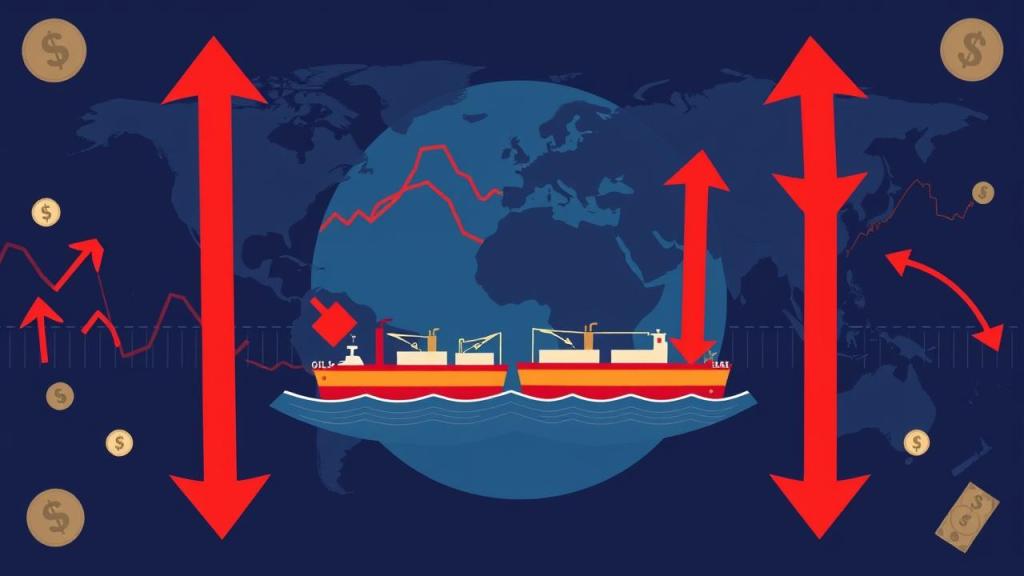
🌐 Global Economy Briefing — 2026-04-17
The global economy is navigating its most turbulent stretch in years, as an escalating Middle East conflict has triggered the largest oil supply disruption in history, forcing the IMF to downgrade its growth outlook and pushing inflation projections sharply higher. Despite the headwinds, U.S. equity markets defied gravity to post fresh records, while China’s trade engine sputtered under surging energy costs — leaving policymakers worldwide scrambling for responses.
🛢️ Middle East War Triggers Historic Oil Supply Crisis
🔥 Strait of Hormuz Choke Sends Oil Past $100
Brent crude surged past $100 per barrel this week as ongoing attacks on energy infrastructure and tanker restrictions through the Strait of Hormuz produced the largest oil supply disruption in recorded history — cutting global supply by 10.1 million barrels per day in March alone.
📰 A Conflict That Rewired the World’s Energy Plumbing
The Middle East conflict, which intensified earlier this year, has put approximately 20% of global seaborne oil trade at risk by targeting the Strait of Hormuz — the critical chokepoint through which nearly a third of the world’s liquefied natural gas also passes. Production shut-ins averaged 7.5 million barrels per day in March and are expected to peak at 9.1 million b/d in April, overwhelming the ability of non-OPEC producers to compensate in the short term.
📊 KEY DATA
▸ Brent crude: ~$100.19/bbl (Apr 14) ▸ Global oil supply cut: −10.1 mb/d in March ▸ Peak production shut-in: 9.1 mb/d (April) ▸ Global oil demand contraction: −2.3 mb/d YoY in April ▸ PCE inflation impact (3-quarter Hormuz closure): +1.47 percentage points
🌍 Energy Pain Spreads from Asia’s Factories to African Consumers
Asian manufacturers dependent on Middle Eastern crude face sharply higher production costs, squeezing margins across electronics, auto, and chemical supply chains. Sub-Saharan Africa — already grappling with fuel import bills — faces median inflation rising from 3.4% in 2025 to 5% in 2026. Shipping rerouting around the Cape of Good Hope is adding weeks to delivery times and billions in freight costs.
👁 WHAT TO WATCH
Monitor the IEA’s next monthly oil market update (early May) for revised supply and demand figures. Any diplomatic breakthrough — or further escalation — around Hormuz tanker passage will move oil prices sharply. OPEC+ emergency meetings and strategic reserve releases by the US, EU, and Japan are the key policy levers to watch.
🎙 EXPERT TAKE
“The world has never experienced a supply disruption of this scale sustained over multiple months. Central banks face a brutal trade-off: tighten to fight oil-driven inflation, or ease to cushion the growth blow.” — IEA Oil Market Report, April 2026
💡 The Energy Crisis Is Now the Economy’s Defining Variable
Until the Strait of Hormuz reopens freely, every other economic forecast — growth, inflation, interest rates — carries an asterisk the size of a supertanker.
📉 IMF Slashes Global Growth Forecast at Spring Meetings
🔥 War Darkens the IMF’s Outlook for the World
The IMF’s April 2026 World Economic Outlook, released during the Spring Meetings on April 14, cut the global growth projection to 3.1% for 2026 — well below the pre-pandemic average — while raising the headline inflation forecast to 4.4%, as the Middle East conflict reshapes the fundamental assumptions underpinning the global economy.
📰 From January Optimism to April Alarm in Three Months
Just three months ago, the IMF’s January update reflected cautious optimism, projecting modestly stronger growth. The outbreak of the Middle East conflict, its energy market consequences, and renewed geopolitical fragmentation have forced a dramatic reassessment. The fund now explicitly identifies a prolonged conflict, deeper fragmentation, and renewed trade tensions as the three biggest risks to an already fragile baseline.
📊 KEY DATA
▸ Global GDP growth 2026: 3.1% (downgraded) ▸ Global GDP growth 2027: 3.2% ▸ Global headline inflation 2026: 4.4% ▸ Emerging market growth: 3.9% (down from 4.2%) ▸ Emerging Asia GDP growth: 5.0% (down from 5.6% in 2025) ▸ South Asia growth: 6.3% (down from 7.0%)
🌍 Developing Nations Caught in a Triple Squeeze
Developing nations face simultaneous pressure from higher energy import costs, tighter global financial conditions as investors flee to safe havens, and weaker demand from advanced economies. The IMF urged emerging markets to deploy “narrowly targeted” fiscal measures to cushion the energy shock without blowing out deficits. Countries with high commodity import dependence — particularly in Southeast Asia, South Asia, and sub-Saharan Africa — face the sharpest growth deductions.
👁 WHAT TO WATCH
The IMF and World Bank Spring Meetings (April 14–19, Washington D.C.) will produce further policy communiqués. Watch for the G20 finance ministers’ response statement. The IMF’s next Fiscal Monitor update will detail which governments have the most fiscal room to absorb the shock.
🎙 EXPERT TAKE
“Geopolitical fragmentation is no longer a tail risk — it is the baseline. The speed with which this conflict has repriced global growth expectations is a stark reminder of how exposed the world remains to supply-side shocks.” — IMF Chief Economist, Spring Meetings Press Briefing, April 14, 2026
💡 The IMF’s Warning Is a Call for Coordinated Global Action
With growth slowing and inflation rising simultaneously, the world faces a stagflationary threat that individual countries cannot navigate alone — making multilateral coordination more urgent than at any point since 2020.
🇺🇸 Wall Street Hits Records as Earnings Optimism Overwhelms Fear
🔥 Nasdaq’s 12-Session Win Streak — Best Since 2009
The Nasdaq Composite closed April 15–16 with its 12th consecutive positive session — its longest winning run since 2009 — while the S&P 500 posted a new record close at 7,041, as investors bet on a potential resolution to the Iran conflict and strong corporate earnings to carry markets through the macro turbulence.
📰 Cheaper Valuations and Earnings Growth Rebuild Investor Confidence
After a sharp valuation reset earlier in the year — large-cap stocks fell from ~25x to ~19.5x earnings — investors appear to be treating current prices as a buying opportunity, especially with S&P 500 earnings projected to grow approximately 16% in 2026. The labor market remains stable (low-hire, low-fire dynamics), reducing fears of a hard economic landing even as global risks mount.
📊 KEY DATA
▸ S&P 500 close: 7,041.28 (+0.26%) ▸ Nasdaq close: 24,102.70 (+0.36%) ▸ Large-cap P/E ratio: ~19.5x (down from ~25x at year-start) ▸ S&P 500 earnings growth forecast 2026: ~16% ▸ Nasdaq winning streak: 12 consecutive sessions
🌍 Dollar Strength Keeps Pressure on Emerging Market Currencies
The U.S. equity rally has been accompanied by safe-haven dollar demand, putting pressure on emerging market currencies — particularly those of oil-importing nations. A stronger dollar raises the cost of dollar-denominated debt servicing for governments across Asia, Africa, and Latin America, tightening financial conditions precisely when fiscal buffers are already strained.
👁 WHAT TO WATCH
The Q1 2026 earnings season kicks into high gear the week of April 20. Watch how major technology and energy companies characterize forward guidance amid the oil shock. The Fed’s next rate decision and any commentary on oil-driven inflation will be pivotal market movers.
🎙 EXPERT TAKE
“Markets are pricing in a best-case scenario for the conflict — a short, contained disruption. If that optimism proves premature, the correction could be swift and severe.” — J.P. Morgan Asset Management, April 2026 Investment Outlook
💡 Stocks Are Betting on Peace — the Trade-Off Is Enormous
Wall Street’s record run is effectively a peace dividend priced in advance — the higher the market climbs on that assumption, the steeper the fall if the conflict drags on.
🇨🇳 China’s Trade Engine Stalls as Asia Braces for Energy Crunch
🔥 Export Growth Misses, Imports Surge on Soaring Energy Costs
China’s March trade data delivered a mixed signal: export growth came in below expectations as manufacturers struggled with surging energy costs from Middle East supply disruptions, while imports jumped more than expected — driven largely by expensive energy purchases — producing a narrower-than-forecast trade surplus.
📰 Beijing’s Stability Strategy Meets an Unstable World
China entered 2026 with a carefully calibrated economic blueprint targeting stability and strategic growth, with GDP growth targeted at around 4.4–4.5%. That strategy assumed relatively stable energy markets — an assumption the Middle East conflict has shattered. China’s customs vice minister described the global oil price environment as “fiercely fluctuating” and the trade outlook as “complex and severe,” as the export-reliant economy faces headwinds from both higher input costs and weaker global demand.
📊 KEY DATA
▸ IMF China GDP forecast 2026: 4.4% (revised down from 4.5%) ▸ Emerging Asia inflation 2026: 3.6% (rising) ▸ South Asia growth 2026: 6.3% (down from 7.0%) ▸ Emerging Asia GDP growth: 5.0% (from 5.6% in 2025) ▸ China import growth: largest surge in 4+ years (March)
🌍 Chinese Overcapacity Squeezes European Manufacturers Too
Beyond the energy shock, China’s global economic footprint continues to generate friction with Europe, where Chinese overcapacity is depressing production prices and squeezing the margins of European manufacturers in an already fragile growth environment. Spain’s Prime Minister Sánchez, visiting Beijing in mid-April, called directly on China to pursue more balanced trade relations: “Let China open up, so that Europe does not have to close itself off.”
👁 WHAT TO WATCH
China’s Q1 2026 GDP data release (expected late April) will be the definitive gauge of how the energy shock has hit domestic growth. Watch for Beijing’s fiscal stimulus announcements — particularly any expansion of consumer subsidies or infrastructure spending. EU-China trade negotiations also remain a key flashpoint through mid-2026.
🎙 EXPERT TAKE
“China’s growth model is being stress-tested simultaneously by energy cost shocks, weak domestic consumption, and rising geopolitical barriers to its exports. The next two quarters will reveal how much resilience Beijing’s policy toolkit actually has.” — Deutsche Bank Research, March 2026
💡 Asia’s Growth Story Now Hinges on How Long the Oil Shock Lasts
From Chinese factories to South Asian households, the Middle East conflict has made energy price duration — not policy ambition — the central variable determining Asia’s economic trajectory in 2026.
※ This content is automatically generated from public news sources. For reference only — not investment advice.

